



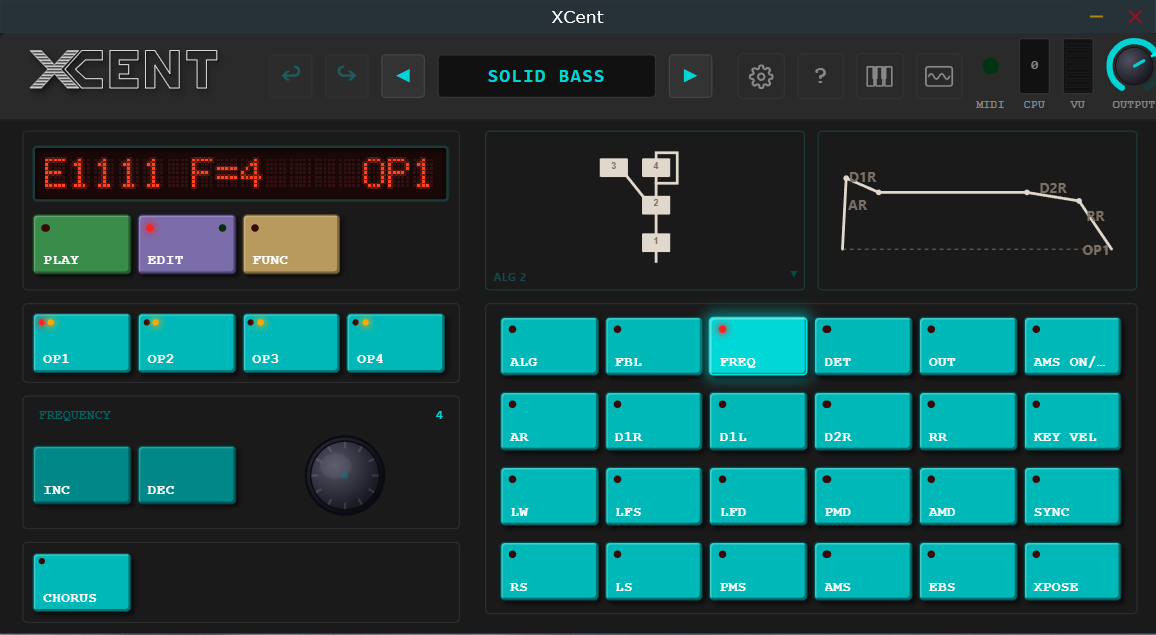
The Yamaha DX100 emulation nobody asked for, built exactly the way nobody bothered.
Somewhere in a landfill — or maybe your aunt's basement — there's a Yamaha DX100. It ran on six C batteries (because the DC port has cracked solder joints), had a dot-matrix LCD the size of a postage stamp, and produced FM tones so aggressively digital they looped back around to character. It was not prestigious. It did not care.
XCent is that synth, without the batteries, without the 2.7kg of drity black plastic, and with significantly less explaining to do at airport security.
What makes XCent different from the other FM plugins you already own
- Emulates the YM2164 OPP chip specifically — not its more famous cousin, not a generic FM engine wearing a costume. The YM2164 has quirks. We kept them.
- Runs the FM engine at the chip's native 55,930 Hz sample rate, then resamples properly. Because running it at 44.1kHz and calling it authentic is the plugin equivalent of putting a photo of a burger on the box.
- DAC quantization, aliasing, and a sluggish reconstruction filter are all present and accounted for. This is not a bug section. This is the sound.
- 192 factory voices sourced straight from the original ROM plus velocity imported from the FB-01.
- All 8 algorithms, full 8-voice polyphony, and operator-level control for when you've decided this is your personality now.
XCent doesn't try to be a DX7. The DX7 doesn't try to be a DX100. We're all better for it.
All for less than the shipping cost on a broken one from eBay.
Changelog
v0.15.21 — September 16, 2026
Changes
- Framework updated to JUCE 9.0.2 (from 9.0.1). Nothing about how XCent sounds, looks or behaves changes: every render the test suite compares against its tracked reference is unchanged, the fallback screens still draw in the bundled Roboto Mono, and the plugin passes the same validation as before in every format. Saved projects keep loading (plugin identifiers unchanged).
- Two third-party licence texts refreshed. JUCE 9.0.2 ships the FLAC and Ogg Vorbis licences without the explanatory preamble JUCE used to place above them, so XCent's copies match their source again. The licence terms are unchanged: both still carry the Xiph copyright lines and their BSD text.
- House style: the company name is written "Knives on Strings", lowercase "on". Prose across the repo — the EULA, the third-party notices, the manual, the README, the installer's displayed strings and the in-app About box — now spells it consistently. Identifiers were already correct and are unchanged:
COMPANY_NAME, thecom.knivesonstrings.xcentbundle/CLAP IDs,PLUGIN_MANUFACTURER_CODE KnoS, and the spacelessKnivesOnStringssettings folder thatDocuments/KnivesOnStrings/XCentlives under. - Two shipped documents now describe the real product. The manual's "User Data Location" section gives the folder XCent actually uses on every platform —
KnivesOnStrings/XCentinside your Documents folder, including when Documents is redirected into OneDrive — instead of invented per-platform paths for macOS and Linux, and no longer says Settings can move it, because it cannot; the one way to relocate the data is theXCENT_SETTINGS_DIRenvironment variable, which the section now explains. The readme that goes into a release package no longer calls XCent MIT-licensed or open source — it is a commercial product with an end user licence agreement — no longer says it runs Yamaha's ROM firmware, which it neither ships, bundles nor downloads, and names the FM engine, the package contents and the public repository correctly. - The manual describes the right product, and its factory-voice counts add up. The overview no longer says XCent runs Yamaha's ROM firmware — it does not, and it never ships, bundles or downloads one — and instead describes the hardware signal chain XCent actually models. The bank description now accounts for every voice: all 192 factory voices load, 96 filling the four read-only ROM banks and the other 96 arriving pre-loaded in the four writable RAM banks, which start full rather than empty. A new note explains why a bank dump holds 32 voices where a bank holds 24.
- README's front page and the manual's install steps now match the product too. README still claimed XCent "runs actual DX100 ROM firmware ... for 100% accurate" voice handling, restated again in its architecture diagram and source-layout table — the same claim two other shipped documents lost on 2026-09-16, but the scan behind that fix never reached this one. It now says what actually runs: MIDI turned into chip register writes the way the firmware does. The manual's version stamp is current again, and its Windows, macOS, and Linux download/install steps name the installer, package, and tarball by pattern instead of a frozen
0.14.0-rc1, with the Windows and Linux manual-install commands corrected to the paths their own packaging actually produces and the macOS steps naming the.dmgit actually ships instead of a zip that never existed. - Two more stale customer-facing facts corrected. The Linux installer's closing line sent users to the private development repository for support; it now points at the public one, matching the About box and README's own Links section. README.md's version badge, test-count badge, "Current version" line and quoted gate figures had fallen a release behind; all four now read 0.15.21 and today's measured counts, with a new Recent Updates entry for the JUCE 9.0.2 move.
- README's last two stale test figures closed out. The Tests section's "Currently known failures" list still named four tests that no longer fail, and the Source Layout tree quoted a test count several releases old. Both now read today's gate: 608 cases, 606 passed, 1 skipped, 1 expected failure.
- macOS: the plugins and the Standalone now load on Macs other than the one that built them. macOS builds up to now — VST3, CLAP, Audio Unit, LV2 and the Standalone app — looked for their FM engine library in the developer's build folder instead of inside their own bundles, so on any other Mac the host refused to load the plugin and the app would not open ("Library not loaded: @rpath/libNukedOPP.dylib"). Each format now finds the copy it carries. Windows is unaffected.
- macOS installer: signed and notarized. The macOS package build can now sign every plugin format and the Standalone app with an Apple Developer ID certificate, sign the installer package, and have Apple notarize both the installer and the disk image, so a finished release opens without a Gatekeeper security warning. The disk image's read-me no longer shows a stray Chinese character where an arrow was meant, and it only explains how to get past the security warning when the installer is not notarized. The installer also always puts each format in its standard folder, even when another copy of XCent exists elsewhere on the Mac. No notarized build has been published yet.
- macOS: XCent now runs natively on Intel Macs as well as Apple Silicon. Every macOS format — VST3, CLAP, Audio Unit, LV2 and the Standalone app — is now a universal binary. Until now the Mac builds only contained Apple Silicon code, yet the installer still offered to install on Intel Macs, where nothing would load. The installer now also checks that it can run on the Mac it is opened on before installing anything.
- macOS 15 Sequoia or later is now required (was macOS 10.15 Catalina). The installer refuses to install on older versions of macOS.
- The user manual in the macOS disk image always matches the release. The Mac package could carry a manual printed from an earlier version of the text: a test build today still said the Mac version needs macOS 11 or later. The manual is now printed fresh every time a package is built, and a package can no longer be built without it, on macOS or Windows.
- README's bank and patch counts now match the code. The Sound Management section said "4 banks x 8 patches" with per-bank storage "(A-D factory, U1-U4 user)" -- wrong on every count, and naming four RAM banks that do not exist. It now says 8 banks of 24 voices each, names the four read-only ROM banks and four writable RAM banks the code actually has, and states that the RAM banks arrive pre-loaded rather than empty.
- The published release notes no longer carry the development suite's internal detail. Three entries in these notes had their proof tails -- test file names, test-runner figures, internal binary names -- written outside the markers that keep such detail out of the public changelog, so the notes sent to beta testers published them verbatim. All three now end at the sentence that tells a reader what changed, and a standing check keeps it that way.
- The manual no longer offers a macOS install route that does not exist. Its "macOS (manual)" steps had you copy
XCent.vst3,XCent.clap,XCent.componentandXCent.appout of aplugins/folder -- a folder no macOS download has ever contained. What macOS ships is one disk image holding one installer package, and the manual now says so: the installer places the formats system-wide, in the four locations it already listed, you pick which formats go in while it runs, and a per-user install under~/Library/Audio/Plug-Ins/is not offered in this release. The genuinely useful part is kept, attached to where it actually applies -- if a DAW does not see XCent after installing, the disk image'sclear-quarantine.shclears the quarantine flag from every location XCent installs to and refreshes the AU cache -- and the disk image's own readme now says that in the same terms instead of offering a hand-copy first. Whether macOS should get a manual or per-user install route at all is written down as an open decision rather than left implied by instructions that did not work.
v0.15.20 — September 16, 2026
Fixes
- The interface now always renders in its intended typefaces. Every font the interface draws with now ships inside XCent. Before, a computer without Roboto Mono installed showed most of the interface in Courier New, and symbols such as the favourite star, the undo and redo arrows, the patch-navigation arrows, the padlock on ROM banks and the scope's play and freeze marks came from whatever symbol or emoji fonts the operating system had. The fonts are bundled now and those symbols are drawn as vector icons, so the interface looks the same on every machine.
- The fallback screens use the interface's font. The screens XCent shows in place of its interface when the interface cannot start (WebView2 missing, the interface failing to load, or the chip-emulation library missing) now draw their text and buttons in the same Roboto Mono as the interface instead of the operating system's default font.
- The manual PDF no longer depends on the build machine's fonts. The arrows, patch-navigation pointers and the star, gear, clock and keyboard symbols in the manual are drawn as vector icons, so the PDF contains only XCent's own fonts.
- The licence texts now come with XCent on Windows. The installer and the zip include XCent's licence, the third-party notices and the full third-party licence texts — among them the SIL Open Font License of the bundled fonts — as the macOS disk image already did. The installer puts them next to the Standalone app.
- Complete third-party licence texts. The third-party notices now cover every third-party component built into XCent, and every XCent download includes the licence texts those components call for — among them those of HarfBuzz, SheenBidi, LunaSVG, FLAC, Ogg Vorbis, the CLAP SDK and Microsoft's WebView2 SDK.
- The About box now shows the plugin's real version. Since 0.15.12 it had shown "v0.15.11" — a frozen build-counter artifact — no matter what version was actually installed. It now reads the same version number as everywhere else in XCent.
v0.15.19 — September 8, 2026
Fixes
- No audible change. An out-of-bounds table read in the chip emulator that only the test harness could trigger is now masked; every render fingerprint and reference comparison is unchanged.
v0.15.18 — September 7, 2026
Fixes
- Closing XCent no longer crashes at the very end. Shutting the Standalone window — or a DAW quitting with XCent loaded — could end in a crash report after everything had already been saved. Nothing was lost when it happened, but Windows logged an application error and some hosts reported it back to you on the next launch. XCent's preferences store (your theme, UI scale, tour progress, privacy choice) was being taken down after the framework it relies on had already gone; it is now written out and released while the framework is still up.
- A factory patch reopened with a project no longer shows the modified indicator. Save a project sitting on any of the 100/200/300/400 factory banks, reopen it, and XCent marked the voice as edited even though you had changed nothing — so the LCD showed the modified state and Recall Edit looked meaningful when there was nothing to recall. Untouched factory patches now come back clean; a slot whose contents really did change under the project is still flagged, exactly as before.
v0.15.17 — September 7, 2026
Changes
- Two new environment variables, for anyone who wants XCent's files somewhere else or telemetry off for one launch.
XCENT_SETTINGS_DIR(an absolute path) relocates everything XCent writes for you — the patch library, your preferences and the debug log — away fromDocuments/KnivesOnStrings/XCent; useful for a portable install, a second profile, or keeping a test run out of your real data.XCENT_TELEMETRY_DISABLED=1switches telemetry off for that launch: no worker thread is started and nothing is sent, whatever the in-app setting says. Both are additions — the in-app Privacy opt-out is unchanged and still the normal way to turn telemetry off.
v0.15.16 — September 6, 2026
Fixes
- CLAP hosts now refresh the plugin's parameter values after loading a project; before, the values were restored correctly but the host could keep showing the old ones.
v0.15.15 — September 6, 2026
Fixes
- In hosts that build the plugin window well before showing it, the editor could replace a working UI with the "user-interface layer did not signal ready" panel about 8 seconds after construction. The watchdog now starts when the host actually attaches the window instead.
v0.15.14 — September 6, 2026
Fixes
- Opening the plugin in a VST3 host could show a solid white window instead of the UI, until the window was resized. XCent's editor is not resizable, so for an affected user there was no way out of it. The editor now re-asserts the web view the moment the host window attaches, and retries briefly until the UI reports that it is ready.
v0.15.13 — September 6, 2026
Changes
- Framework upgraded to JUCE 9.0.1 (from 8.0.12). No audible change: every harness render, including the three golden references, is byte-identical to the JUCE 8 build of the same code, and pluginval strictness 10 passes in both modes. Saved projects keep loading (plugin identifiers unchanged).
v0.15.12 — September 5, 2026
Fixes
- Windows: XCent now loads in hosts that use Steinberg's module loader (Cubase / Nuendo plugin-guard, pluginval's VST3 validator). Since 0.15.x the Nuked-OPP chip emulation ships as a separate
NukedOPP.dllbeside the plugin so the LGPL relink right is real. Hosts whose loader does not search the plugin's own folder could not find that DLL and refused to load the plugin at all. The DLL is now delay-loaded and bound from the plugin's own directory before first use; if it is ever missing, the plugin still loads, stays silent and shows an explanation panel instead of failing or crashing.
v0.15.11 — May 17, 2026
Features
- Anonymous opt-out telemetry + in-plugin issue reporter are now on by default. The kos-worker Cloudflare backend (api.knivesonstrings.com) is live, so the soft-launch gate on
XCENT_NETWORK_ENABLEDis removed and default builds compile in the full feature: anonymous session events POST to/api/telemetry, the Report-an-Issue button on the About modal pings/api/pingand opens a hosted GitHub-issue form atreport.knivesonstrings.com. First launch shows a mandatory privacy slide at the end of the onboarding tour with the option to opt out. Opt-out is also available any time via Settings → Privacy. All telemetry events are keyed by an anonymous per-install UUID with no personal data. - macOS uninstaller (
uninstall.sh) — DMG now ships anuninstall.shscript that cleanly removes all four plugin bundles (VST3, CLAP, AU, Standalone) and forgets thepkgutilreceipts. User data under~/Documents/KnivesOnStrings/XCent/(patches, preferences, logs) is preserved by default;--purgewipes it too. Bash 3.2-safe so it runs under the macOS system/bin/bash. Flags:--dry-run(preview),--yes(skip prompts),-h(help). Documented in the in-DMGREADME.rtfand inDocs/manual/MANUAL.md.
Refactors
- User preferences consolidated into a single file. Pre-launch cleanup: three storage locations collapsed into one. Before, user preferences were spread across hand-rolled
settings.xml(Standalone only, written in dtor only),preferences.settings(PropertiesFile via UserPreferences — telemetry + network keys), and WebView localStorage (xcent-tour-complete,xcent-tooltips-enabled,xcent-default-modern). After: every user-configurable preference lives inDocuments/KnivesOnStrings/XCent/preferences.settingsunder theui.*namespace, with DAW state still mirroring UI prefs via<XCentPrefs>for in-host persistence. - DEFER14 / DEFER17 dependency framing corrected — the S/H LFO mid-LFS slope refinement and the triangle/saw LFO pitch-waveshape residual were both labelled "blocked on DSP23" in TODO.md, but DSP23 closed 2026-05-04 with its four correction tables (
opp::kPmsScale,opp::kAmsScale,opp::kArRemap,opp::kFblRemap) already in place — and the May-12 sweeps that filed both DEFER entries were run *with* that correction applied. TODO.md now correctly identifies them as separate divergences outside the scope of DSP23's amplitude/AR/feedback compensation, in the same "likely irreducible without Nuked-OPP internal patching" category as DSP23's documented FBL=6/7 and AR=18–30 chip-level residuals.
v0.15.1-rc2 — May 14, 2026
Fixes
- Portamento now matches DX100 hardware (DEFER18) — Plugin glide was previously ~2.2× slower than hardware at every portaTime, and engaged under more conditions than the real device. Same-day fix after the 2026-05-14 hardware sweep: rate scaled by 22/10 in
FirmwareLogic::computePortaRateand triggering tightened to mono + legato. Post-fix sweep matches hardware to a mean |dGlide| of 21 ms across portaTime 10..75. Trigger behaviour now lines up with hardware: portamento only engages whenpolyMono=1AND a previous voice is still held when the new note arrives.portaMode(full-time vs fingered) is preserved for SysEx round-tripping but no longer changes triggering (DX100 treats both modes identically).
v0.15.0-rc2 — May 12, 2026
Fixes
- TEL1 host_version on Standalone (macOS) —
/api/issueswas rejecting every form submission withhost_version is required. Plugin now sends the OS version (e.g."macOS 14.5","Windows 11") viajuce::SystemStats::getOperatingSystemName()for both Standalone and DAW contexts — JUCE doesn't expose the host application's version separately, but the OS string is a useful triage signal that is always non-empty. - TEL1 worker-thread crash on quit (macOS) —
XCent quit unexpectedlySIGSEGV insideobjc_autoreleasePoolPopduring process teardown. The telemetry worker accumulated Cocoa autorelease objects from each POST into its outer JUCE-managed pool; on shutdown that pool teardown raced with Cocoa finalisation and dereferenced freed memory. Fix wraps each drain + each POST in a scopedJUCE_AUTORELEASEPOOL(releases transient objects per-iteration) and tightens the POST timeout from 5s to 1.5s so the worker can finish in-flight requests before being abandoned by the 2s join window. Same fix applied toIssueReporter::ping(). - TEL1
session_endlost on clean quit — The telemetry singleton's destructor only ran during C++ static finalisation, by which point the UserPreferences singleton holdinginstall_idhad already been torn down. The worker's final drain read an empty install_id and the event silently dropped. Fix adds aPluginProcessor-level instance counter that deterministically callsTelemetryClient::stop()from the last-live-instance destructor — while prefs are still alive — so session_end actually POSTs. - Standalone state persistence on macOS — Settings made during a session (theme, scale, displayStyle) were lost on close. Worked on Windows. Two compounding bugs:
shutdown()ordering — Our customXCentStandaloneApp::shutdown()destroyedmainWindowbefore ever callingsavePluginState(), sopluginPropertiesretained whatever stalefilterStatewas last cached.savePluginState()is only triggered automatically bysystemRequestedQuit(), which on macOS doesn't fire when the user clicks the window's red close button (only Cmd+Q routes that way). Windows routes window close through systemRequestedQuit, which is why this never surfaced there. Fix callssavePluginState()explicitly inshutdown()before destruction.- Foreign children accumulating in filterState —
setStateInformationcallsapvts.replaceState(ValueTree::fromXml(...)), which adopted ourXCentVoice/XCentRom/Scope/XCentPrefsnodes into the APVTS state tree. Each subsequent save reproduced them viacopyState(), then we *appended* a fresh copy on top — duplicates compounded every cycle, andgetChildByNamereturned the oldest stale match on load. Fix scrubs known foreign-child tags from the APVTS XML before re-appending fresh ones; one user'sfilterStatewent 8705 bytes → 664 bytes after the fix.
Features
- HMAC-signed report-form & API URLs — The hosted issue-report form (
report.knivesonstrings.com) and the kos-worker API endpoints (/api/ping,/api/telemetry,/api/issues) now require an HMAC-SHA256 signature on every request. The plugin signs each URL with a shared secret compiled in via CMake (XCENT_FEEDBACK_FORM_SECRET); the server recomputes the signature and 302-redirects towww.knivesonstrings.com(form) or returns 401 (API) when it doesn't match. Drive-by visits to the form URL or randomcurlagainst the API are no longer enough to reach the endpoints — you have to know the secret. Replay window is ±300 s via a signedtsparam. The secret is a spam moat, not a real credential — rotate by bumping the CMake var + worker env in lockstep. - MIDI CC11 (Expression) — XCent now responds to CC11 as a multiplicative volume scale on top of CC7. CC11=127 (default) is unity — no effect — and lower values attenuate alongside CC7. Lets you ride expression as a separate automation lane from master volume, the way string libraries and wind controllers expect. Not on the original DX100; this is a plugin extension. The routing target will become configurable in a future release (DEFER13: volume / TL bias / off).
- macOS installer (DIST2) — Signed
.pkginstaller wrapped in a.dmgwith embedded README, licence, and auto-generated manual PDF. Welcome / licence screens included; installs VST3, CLAP, AU, and the Standalone app to the standard~/Library/Audio/Plug-Ins/paths.clear-quarantine.shhelper ships alongside for users who download the raw plugin folders rather than running the installer — strips Gatekeeper quarantine attributes and auto-refreshes the AU cache. - TX81Z output stage (DEFER6, Phase A) — Added a
TX81ZOutputStageimplementing the YM3012 / DX21–DX27–TX81Z analog output path alongside the existing DX100 stage. Output-stage selector lives in Settings → Sound, feature-flagged off until hardware calibration completes.
Fixes
- Bank/slot vs VCED state desync (UI39) — When you save a project, edit the patch bank externally (e.g. SysEx import that overwrites a slot), then reopen the project, the LCD used to claim the slot was unchanged even though the actual sound came from the saved snapshot. Restore now compares the saved voice against the bank's current contents at the same slot and shows the modified-indicator when they differ — so you can see at a glance that what you're hearing isn't what the slot label says, and use Recall to reload the slot's current contents if you want to.
v0.14.0-rc1 — May 9, 2026
Features
- First-run onboarding tour (UI43) — Spotlight overlay walks new users through Modes, Operators, parameter editing, Modern view, Func mode, and the Patch browser. Dismissed permanently after first run; re-runnable any time from Settings → Appearance → Onboarding.
- Parameter button hover tooltips — Edit/Func grid buttons show the full parameter name + range after a 500 ms hover. Toggle in Settings → Appearance → Input. Works for the EZ panel knobs and sliders too.
- Default to Modern view — New setting (Settings → Appearance → Input) makes Edit mode automatically open Modern view (formerly "EZ mode").
- Settings layout reflow — Appearance tab uses a two-column layout; window scale, skin, and display colour on the left, scope/indicator/input/onboarding on the right.
- Terminology — UI labels now refer to "Modern view" instead of "EZ mode".
Fixes
- Floating UI off-screen at non-100% UI scale (root-cause fix) — Tooltips, right-click context menus, copy-to-operator menus, and the tag picker were drifting / clipping off-screen at any UI scale other than 100%. The plugin root has
transform: scale()for the user UI-scale setting, which makes it the containing block forposition: fixeddescendants — viewport-space coords fromgetBoundingClientRect()and mouse events were being re-scaled by the transform. Symptom previously patched twice with viewport clamping; this release fixes the underlying cause by portaling all floating elements todocument.body. - LCD modified-indicator case flip on first edit (UI42) — Two bugs:
markEditBufferDirty()was inside theif (msg.param)guard inPARAM_UPDATEhandler, skipping the call when no param selected; andpadStringinDotMatrixLcdcalled.toUpperCase()on every string, hiding E→e. - AMS ON LCD display — Renamed AMS ON column to
AM=, fixedampModSensflag wiring. - Inter font + contrast pass on patch browser.
- Manual link —
/xcent/manualredirect target.
Known issues / RC scope
- v1 launch blockers UI39 (bank/slot vs VCED desync), DIST2 (macOS installer), DIST5 (Windows EV signing), and BUG1 (rapid-note clicking, deferred) remain open and are tracked toward v1.0 (see
Docs/v1-requirements.md).
v0.12.7 — May 7, 2026
Fixes
- DSP28 — Breath Controller EG bias formula corrected. The BC EG bias (breath controller → operator volume) was inverted and missing from the note-on path, so patches using breath control (
B10 BC1Trumpet,C18 <BC1> Sax,C19 BC1 Hrmnca) produced flat volume regardless of CC2. Formula polarity fixed:biasAmount = (127 − CC2) × egBiasSens × bcEgBias / 2540. Low CC2 now adds attenuation (as on hardware); CC2 = 127 yields no extra attenuation. Bias now applied at note-on time (applyVoiceToChannel) in addition to the live CC2 handler, so notes triggered before CC2 arrives are weighted correctly. Divisor 2540 calibrated to hardware B10 measurement (20 TL units range for egBiasSens = 4, bcEgBias = 99). Plugin BC curve shape matches hardware; a ~3 dB systematic offset across all CC2 values is the same calibration gap seen in non-BC patches and is not BC-specific. - Garbled log output on Windows. Debug log lines were garbled because
juce::String::formattedroutes through_vsnwprintfand interprets%sarguments aswchar_t*. Each pair of ASCII bytes was encoded as a UTF-16LE codepoint and then re-encoded as 3-byte UTF-8, producing unreadable log files. Fixed by replacing all macro-level string formatting withsnprintf(narrow printf), which handles%scorrectly on all platforms. Log files from v0.12.7 onward are plain readable ASCII/UTF-8. - WebView resource URL — Nuendo / plugin-guard environments. In Steinberg's VST3 plugin-guard subprocess (Nuendo 15, Cubase 15), JUCE passes the full URL including scheme and host (
xcent://xcent.localhost/index.html) to the resource provider callback rather than just the path. The resource table lookup failed to find any match, producing a blank white screen. Fixed by stripping the scheme + host prefix before the table lookup. The UI now loads correctly in plugin-guard hosts.
v0.12.6 — May 5, 2026
Features
- Configurable WebView2 cache location. New environment variable
XCENT_WEBVIEW2_DATA. If set to an absolute path, the plugin uses that directory as the WebView2 user-data folder instead of the default%LocalAppData%\KnivesOnStrings\XCent\WebView2. Workaround for sandboxed hosts that don't permit LOCALAPPDATA writes — set the env var to a path the host *can* write to (the plugin install directory, a Documents subfolder, etc.) and reopen.
Fixes
- Stripped-runtime detection.
WebView2Detector::isWebView2AvailableForJuce()now cross-checks the registry version against the actual presence ofmsedgewebview2.exeon disk. Some "audio optimization" scripts (Atlas OS, BlackViper variants, Win11Debloat) strip the WebView2 runtime files but leave the EdgeUpdate registry key behind. Previously we trusted the registry, constructed the WebView, and got a white screen when the loader couldn't find the binary. The new check searches the two standard install bases (%ProgramFiles(x86)%\Microsoft\EdgeWebViewand%LocalAppData%\Microsoft\EdgeWebView) for the version the registry reports; if it's not there, the runtime is treated as missing and the WebView2 missing panel is shown — same as a fresh install with no runtime at all. Either way the user gets the "install WebView2" prompt with a working button. - Host process diagnostics + write probe.
HostDiagnostics.cppnow runs three checks in the editor constructor: - Host process info. Logs the host EXE name, full path, and Windows token integrity level (Untrusted/Low/Medium/High/System). Detects AppContainer sandboxes used by FL Studio and some Cubase configurations.
- WebView2 runtime cross-check. Logs the registry-reported version *and* the resolved on-disk path to
msedgewebview2.exe. If the path is empty while the version is non-empty, an explicitSTALE REGISTRYerror line is emitted naming the likely culprit scripts. - User-data-folder write probe. Before the WebView is even constructed, attempt to create + delete a probe file in the cache folder. If the host sandbox is blocking writes (Cubase VST3 sandbox, restricted ACL on LOCALAPPDATA), the editor skips the WebView entirely and shows the failure panel with the specific Win32 error string and an environment-variable workaround.
v0.12.5 — May 5, 2026
Features
- Native fallback panel when the UI fails to load. Beta-tester report: a fresh v0.12.1 install came up to a blank white screen inside the VST3 host. Previous behaviour was diagnostic-blind — if the WebView2 runtime initialised but the page failed to render (cache corruption, JS module load failure, sandbox/AV interference), the editor showed an empty white component with no signal that anything had gone wrong. This release adds two layers of detection on top of the existing
WebView2MissingPanel(which still catches "runtime not installed at all"): pageLoadHadNetworkErrorhook.XCentWebBrowseris now aWebBrowserComponentsubclass that overridespageLoadHadNetworkErrorandpageFinishedLoading, both of which log toxcent.logand feed back to the editor. A network-level error swaps the WebView for a native diagnostic panel immediately with the platform-specific error string.- 8-second
UI_READYwatchdog. A one-shotjuce::Timerarms aftergoToURL. If React'sUI_READYmessage hasn't arrived by the time it fires (typical legitimate load is 1–3 s), the editor falls back to the same diagnostic panel. UI_READY arriving first cancels the watchdog. Network errors arriving first also cancel it. - Diagnostic panel content. The new
WebViewLoadFailedPanelshows failure reason (network error string, or "did not signal ready within Ns"), detected WebView2 runtime version, path toxcent.log, path to the WebView2 cache folder, an "Open log folder" button (shells to the logs directory so testers can grab the file), and a "Clear WebView2 cache" button (deletes the user-data folder so the next plugin instantiation rebuilds it from scratch — fixes ~half of stale-state white-screen reports on similar JUCE WebView plugins). - Installer: WebView2 cache wipe on install and uninstall.
xcent-installer.nsinow removes%LOCALAPPDATA%\KnivesOnStrings\XCent\WebView2in the Finalize section of the install and at the end of the uninstall. Reinstalling a new version always starts with a fresh WebView2 cache, which eliminates "old cache poisons new build" as a class of failure mode without the user having to do anything manually. User data atDocuments\KnivesOnStrings\XCent(patches, prefs, logs) is still preserved across install/uninstall as before.
v0.12.4 — May 3, 2026
Fixes
- CPU meter now shows 0% at idle. The CPU meter was showing 30–50% with no notes playing. Root cause: any MIDI input (active sensing, clock, or other real-time messages from a connected keyboard) kept
midiMessagesnon-empty every block, which prevented the idle flag from engaging and left Nuked-OPM running on silence. Fixed with an early fast-path exit inprocessBlock: if the engine was idle last block, the FIFO is empty, and there is no pending voice change, we store0.0fto the CPU meter and return immediately — skipping APVTS reads, MIDI iteration, SysEx handling,renderBlock, gain apply, and peak metering. The meter now reads 0% at idle and only lights up during active synthesis.
v0.12.3 — May 3, 2026
Features
- Mouse wheel parameter speed +50%.
useWheelControlpreviously stepped 1 unit per tick. Now uses a fractional accumulator with a 1.5 step/tick base: the accumulator alternates 1–2–1–2 (average 1.5), giving exactly 50% faster scrolling without changing coarse-mode (Ctrl+wheel). Accumulator resets on direction reversal and on gesture end.
Fixes
- Undo/redo depth fixed.
undo()andredo()both send aVOICE_RESTOREto C++, which echoes backVOICE_LOADED. The echo calledsetVoiceParams()which clears both the undo and redo stacks as a side effect — so after the first undo the remaining history and all redo state was wiped. Fixed by addingsetVoiceParamsKeepHistory()to the store (syncsvoiceParamsonly, no stack side-effect) and using it in the VOICE_RESTORE echo path inApp.jsx. Undo stack depth is now the full 50-entry limit; redo works correctly across multiple undo steps. - LCD prefix: patch-level params no longer show operator mask. In EDIT mode, operator-scoped params (AR, D1R, OUT, etc.) still display
E1111 OUT=23 OP1— the mask shows which operators are active. Patch-level params (ALG, FBL, PMD, pitchBend, transpose, etc.) now displayE ALG=1instead ofE1111 ALG=1. The 4-char operator mask was unused for these params and caused long names likePBend Range=12to be truncated.
v0.12.2 — May 3, 2026
Features
- UI37: mouse wheel for pitch-bend and mod-wheel controls. Both on-screen wheels now respond to mouse scroll when the global Settings → Mouse Wheel toggle is on.
- BEND: ±5% of range per tick (Ctrl/⌘ = ±10%), springs back to center (8192) automatically after 350 ms of quiet — matching the hardware pitch-wheel spring-return behaviour.
- MOD: ±1 per tick (Ctrl/⌘ = coarse), holds the scrolled value.
Fixes
- DSP24-KVS: ROM-extracted KVS velocity → TL offset table. The per-operator key-velocity-sensitivity (KVS) attenuation previously used a quadratic approximation. At KVS=5, vel=16, the approximation over-attenuated by ~9 dB vs hardware. The error grew at low velocities with high KVS settings (up to −10 dB at vel=16). Velocity → TL is now a direct ROM-extracted lookup table sweeping all 128 MIDI velocities × 8 KVS levels through the actual DX100 ROM firmware. ROM values are monotonically non-increasing with velocity; KVS=0 is all zeros; KVS=7 at vel=1 = 78 TL units (≈46 dB attenuation). Zero regressions on 552-case test suite.
- UI42 partial — two bugs fixed + diagnostic added. Two confirmed bugs causing erroneous dirty-flag state were fixed: 1. VOICE_RESTORE echo reset dirty after undo. The undo path sent VOICE_RESTORE to C++, which echoed back
VOICE_LOADEDwith nobank/slot/name. App.jsx calledsetPatchLoaded(undefined, …)which seteditBufferDirty=false— immediately undoing the dirty flag set by the undo action itself. Fix:VOICE_LOADEDhandler now guardssetPatchLoadedbehindmsg.bank != null. 2. masterTune PARAM_UPDATE marked dirty on every patch load. After eachnotifyVoiceLoaded, C++ sent a separatePARAM_UPDATEfor masterTune, which triggeredmarkEditBufferDirty()→ dirty=true immediately after loading any patch or navigating prev/next. Fix: masterTune now travels as a field in theVOICE_LOADEDpayload and is applied viasetVoiceParamwithout callingmarkEditBufferDirty. - UI39: SysEx-loaded voice display fix (partial). Two parts of the bank/slot desync were addressed: 1. Display fallback for slot-less voices. When a voice is loaded with no bank/slot origin (SysEx receive, Init Voice), the LCD PLAY mode now shows
P<voice-name>instead of the confusingP<bank>:<voice-name>format (e.g.PSysEx:BRASSCOMP). 2. State preservation on SysEx receive. When a single-voice SysEx is received via MIDI,currentBank_/currentSlot_are now set to"SysEx"/-1sogetStateInformationsaves the correct origin. Previously, the saved bank/slot pointed to whatever was loaded before the SysEx arrived, causing the wrong patch to be shown on project restore. - CPU display. VuMeter rAF loop now self-terminates when the meter fully decays to zero (was running at 60 fps continuously even at idle). CPU meter EMA decay is faster (α=0.06 vs 0.033) — stale high readings clear in ~0.5 s instead of ~1 s. Attack still fast (α=0.3) for spikes.
v0.12.0 — April 29, 2026
Fixes
- Pitch EG level scaling (DSP13). Level-to-pitch conversion now uses the ROM-extracted
kPegLevelScale[100]table (DX21 ROM$DCDD) instead of the previous(level-50)*5*3approximation. Internally represented as a 16-bit value centered at0x3000(±48 semitones full swing). Level 50 = zero offset; Level 99 = +48 semitones; Level 0 = −48 semitones. - Pitch EG rate stepping (DSP12). Per-firmware-model PEG:
- DX100 / FB01: instant snap to L1 at note-on, no subsequent movement.
- DX21 / TX81Z / DX11: ROM rate-accumulator algorithm — step =
lfoDelayRate[99−R]per CMI tick (~13.7 Hz). Phase machine: attack1 (→L1) → attack2 (→L2) → sustain-hold → release (→L3) → idle. Note-off triggers release. Instant sentinel (R=99) snaps and advances phase in a single tick.
v0.11.10 — April 27, 2026
Features
- Hardware-comparison pipeline (new). Tooling shipped this version for the DSP17 family of investigations (reusable for DSP12/DSP13 PEG extraction next).
Fixes
- +3 dB analog-stage calibration (DSP17 / DSP21). Hardware-comparison data showed the plugin was systematically ~3 dB quieter than the DX100 line-out across all 8 algorithms after segmentation contamination was ruled out. Adopted
kPassbandGainDb = +2.5 dBnet, then refactored the constant into two semantically-distinct components: kFilterPassbandGainDb = -0.5 dB— IC12 active LPF passband loss, rigorously derived from the dual-input differential drive topology:Vout/Vnode_A = (Z_C3 - Z_C2) / (R + Z_C3)with R = R2 = R3 = 2.2 kΩ. Yields ≈-0.6 to -2.7 dB across audio (low-frequency limit modeled as flat -0.5 dB). The previous "R1/(R2∥R3) divider" framing in the spec doc was a hand-wave (op-amp inputs are high-Z so they don't load that way) — magnitude was right by coincidence.kOutputCalibrationDb = +3.0 dB— empirical calibration to match the absolute level of the hardware reference recordings. Not attributable to a single schematic stage: IC21 output driver (+14.7 dB inverting amp), VR3 volume pot, and audio-interface input gain during reference capture are all unmodeled and collapsed into the implicit "DAC max → host ±1.0" mapping. Documented as such.- ROM-extracted PMD/AMD scaling tables (DSP19a). A diagnostic test revealed that the LFO-depth path was writing voice PMD/AMD (VCED range 0–99) directly to the YM2164 register. The actual DX100 firmware applies a non-trivial ROM-extracted scaling. Tables extracted by sweeping the actual DX100 v1.1 ROM in the HD6303 emulator:
- PMD: approximately linear (~127/99 expansion). voice 80 → reg 102. voice 99 → reg 127 (full scale).
- AMD: dramatically non-linear with an exponential top end. voice 50 → reg 16 (32% of register range); voice 80 → reg 37 (29%); voice 90 → reg 54 (60%); voice 99 → reg 127 (full scale).
- DSP18 patch 102 KC — verified, no regression. User-supplied hardware capture for patch 102 (codebase A02 Uprt Piano) across MIDI 57–63 (A3..D#4). Per-note H1/H2/H3/centroid + pitch analysis: plugin tracks hardware within ±1 dB on every harmonic and ±0.04 cents on pitch across the captured range. The KC break the user observed in v0.11.6 is not present in current code — almost certainly closed by DSP19a + the +3 dB calibration. Status: verified in narrow range; wider chromatic capture would formally close.
Known issues (carried over from v0.11.9)
- UI42 P1 v1 blocker — modified-indicator case flip never fires on user edit. See v0.11.9 entry below and
Docs/TODO.mdUI42 for full diagnostic context.
v0.11.9 — April 25, 2026
Features
- Play-mode LCD mode letter (clean state only — see UI42 for dirty). The LCD now prepends
Pto the patch identifier in PLAY mode, matching the DX100 hardware convention (was previously no leading letter). - Modified Indicator setting. Settings → Appearance → Modified Indicator. Two styles, both visible and persistable:
- DX Mode (default) — hardware-style: when the dirty bit fires, the mode letter is intended to lowercase (
P/p,E/e,Fstatic). - Standard (\*) — replaces the would-be-lowercase letter with
*. Clean-state display is identical to DX Mode. voiceModifiedpersistence. The voice-modified flag now survives DAW project save/reload and Standalone restart via an atomic on PluginProcessor serialised alongside the voice blob, with bidirectional WebView event sync.
Fixes
- Edit-mode patch-level params (ALG, FBL, LFO\*, PMD, AMD, pitchBend, transpose) were incorrectly showing an
Fprefix on the LCD — they're voice params, not system params, and now correctly getE1111(edit-mode prefix with op-mask). - FUNC mode fallback (no param selected) was rendering
E1111 FUNC MODE. Now correctly shows a staticF FUNC MODE.
v0.11.8 — April 21, 2026
Features
- UI36 — Mouse wheel adjusts EZ-mode parameters. Scroll over any EZ-mode knob, slider, or the main output knob to step its value. Modifier keys scale the step:
- Default wheel: one integer step (or 0.02 for the normalized output knob).
- Ctrl / ⌘ + wheel: coarse — ~10% of full range per tick.
- Shift + wheel: fine — 1/10 of a standard step (for ranges that allow it; integer params stay at 1).
- TOOL1 — Auto-tagger feature upgrade (v2 rules). The corpus-derived tag rules now use twelve features instead of four. Parameter-rule yield jumped from 0 firing rules in v1 to 5:
leadgated to algorithm 2 (conf 0.78 — fires alone)brassgated to algorithm 5 (conf 0.78 — fires alone)organgated to algorithms 1/2/3 (conf 0.75 — fires alone)percon algorithms 3/4/5/7 andstringson 2/3/5/6/7 (both fire as secondary signals combined with a name hint)mouseWheelEnabledpersisted setting. Joinstheme,uiScale,displayStyle, andfb01VelocityModein the state XML.THEME_STATEemitted onUI_READYnow carries bothfb01VelocityModeandmouseWheelEnabledso the UI reflects the saved values at load (previously the former was computed but never consumed by the front-end).
Fixes
- UI35 (final pieces) — ROM banks are read-only, MIDI bulk dumps persist. Two safety gaps in the v0.11 patch model are now closed:
- ROM read-only everywhere. Backend
storePatch,renamePatch, anddeletePatchrefuse to write bank 100/200/300/400 and log a warning. The browser modal disables the Store button on ROM banks (and on Favorites/Recents), with a tooltip explaining *why* it's disabled. ROM bank rows in the tree carry a 🔒 glyph and"read-only ROM bank"hover tooltip. - MIDI VMEM bulk dumps now stick. When a 32-voice bulk dump arrives over MIDI, the audio thread writes it into bank A (as before) *and* sets a deferred pending flag. The editor timer consumes the flag on the message thread, calls
persistUserBankToDisk("A")to write the bank out to disk, and pushes a full bank refresh to the UI so the browser's other 23 slot names update, not just slot 0. A log line records the event for diagnostics.
v0.11.7 — April 19, 2026
Features
- Single-click Windows installer built with NSIS. One executable drops VST3, CLAP, the Standalone, the PDF manual, and
CHANGELOG.mdinto place with a bundled Microsoft Edge WebView2 Runtime fallback for clean machines. Output:build/XCent-Setup-<version>.exe(~6 MB with LZMA /SOLID compression). - Installer behaviour.
- Welcome → License → Install Scope → Components → Install → Finish wizard flow.
- Per-machine (default) or per-user radio choice on a dedicated page after the license:
- Per-machine:
%CommonProgramW6432%\VST3,%CommonProgramW6432%\CLAP,%ProgramFiles%\Knives On Strings\XCent\ - Per-user:
%LOCALAPPDATA%\Programs\Common\VST3,%LOCALAPPDATA%\Programs\Common\CLAP,%LOCALAPPDATA%\Programs\Knives On Strings\XCent\ - WebView2 detection mirrors the in-plugin detection logic — same GUID, same registry key, same minimum major version (109). Bundled Evergreen Bootstrapper only runs when the runtime is missing or too old; already-installed users see a no-op.
- Start Menu shortcuts for the Standalone, the PDF manual, and the uninstaller (when the relevant components are selected).
- Uninstaller registered at the correct HKLM/HKCU Add/Remove Programs key based on install scope. User data at
Documents/KnivesOnStrings/XCent/is intentionally preserved on uninstall. - Documentation regeneration. The user manual is regenerated as
XCent-Manual.pdfat installer build time viamarked+ Microsoft Edge headless (--print-to-pdf). No pandoc or Puppeteer required. The changelog is copied from the repo at build time so it always tracks the released version.
v0.11.6 — April 21, 2026
Fixes
- Blank-UI problem on clean Windows installs. When Microsoft Edge WebView2 Runtime is missing or older than Chromium 109 (required for JUCE 8's resource provider interception), the UI would either show "Can't reach this page https://juce.backend" or just stay blank-white. No more — the plugin now detects this at editor construction time and shows a proper fallback panel explaining what's needed, with a one-click button that opens Microsoft's official installer page.
v0.11.5 — April 20, 2026
Features
- Format picker dialog for SysEx export. The browser's new "Save as SysEx…" action opens a dialog with six target formats:
- DX100 VCED (single voice) / DX100 VMEM (32-voice bank)
- DX21 VCED / VMEM (byte-identical to DX100 but labeled as DX21 for clarity — chorusSwitch is meaningful here)
- TX81Z VCED+ACED (two-message export: ACED first with
LM__8976AEheader + per-op waveform/fixed-freq/EG-shift fields, then VCED) - TX81Z VMEM (32-voice bank with ACED data packed into bytes 73–96 per voice)
- Least-lossy default. The dialog pre-selects the format that preserves the most data for the voice's
hardwareContext.firmware: DX100 voice → DX100 VCED, DX21 → DX21 VCED (keeps chorusSwitch), TX81Z → TX81Z VCED+ACED, DX11 → TX81Z VCED+ACED (lossy, drops PEG), FB01 → DX100 VCED (lossy, drops arVelocitySensitivity). - Field-by-field loss warnings. The dialog shows an orange "DATA LOSS WARNING" section listing exactly which fields will be dropped and their current values, or a green "No data loss" confirmation. Detected losses cover: OPZ per-op fields (waveformSelect, fixedFreqEnabled/Range/Fine, egShift) + TX81Z global fields (reverbRate, fcPitch, fcAmplitude, operatorOnOff) when exporting to OPP formats; DX21 fields (chorusSwitch, footVolumeRange) when exporting to TX81Z; arVelocitySensitivity in all hardware formats (FB-01 export not supported, spec doc 10 §Export Matrix).
Known issues
- TX81Z VCED edge case. The exporter appends
operatorOnOffas byte index 93 of the TX81Z VCED payload, making the data 94 bytes rather than the stated 93. Matches observed TX81Z hardware transmit behaviour but may fail checksum validation against strict 93-byte-only parsers. If this breaks hardware round-trip in beta testing, we'll moveoperatorOnOffto travel via ACED or VMEM exclusively.
v0.11.4 — April 20, 2026
Features
- Internal library is now
.xcbinstead of.syx.Documents/KnivesOnStrings/XCent/Library/containsfactory-a.xcb…factory-d.xcbandmy-sounds.xcb. Preserves allVoiceParamsfields (OPZ waveforms, fixed-freq,arVelocitySensitivity,chorusSwitch,hardwareContext) across save/load — the.syxformat silently dropped all of these. .syxremains an IMPORT format.SysExLibrary::importFile(path.syx)parses external DX100/DX21/FB-01/TX81Z dumps and stores them internally as.xcb. Hardware interchange still works both directions via the dedicated import/export paths;.syxjust isn't used for our own storage anymore.
v0.11.3 — April 20, 2026
Features
- TX81Z VCED+ACED import. Single-voice TX81Z dumps (ACED supplementary + VCED base, transmitted together) are now parsed into a unified
VoiceParamswithhardwareContext = OPZ/TX81Z/TX81Z. The ACED data fills in per-operatorwaveformSelect,fixedFreqEnabled,fixedFreqRange,freqRangeFine,egShift, plus voice-globalreverbRate,fcPitch,fcAmplitude. - TX81Z VMEM bank import. 4096-byte 32-voice bulk dumps (format
04 10 00, distinct from DX100's04 20 00) parse all voices with both VCED and packed-ACED fields unpacked per voice. Context auto-set to OPZ/TX81Z/TX81Z. - DX11 auto-detection. DX11 uses the same ACED+VCED wire format as TX81Z but actively uses the PEG bytes (87–92). The importer now inspects those bytes: if they're the fixed TX81Z pattern (
PR=99, PL=50) or all-zero, context isOPZ/TX81Z/TX81Z; if they look "active" (anything else), context isOPZ/DX11/TX81Zso the firmware-aware PEG behavior kicks in. - DX21 auto-detection. DX100 and DX21 share byte-identical VCED (format
03). On import, the parser defaults to DX100 context; ifchorusSwitch=1(VCED byte 64, a DX21-specific feature the DX100 firmware never sets), it promotes toOPP/DX21/DX21.
Known issues
- TX81Z VMEM byte 73–83 ACED packing is inferred from analysis rather than service-manual page 24 directly.
test_tx81z_vmem_aced_fields_extractedverifies self-consistency, but a real-world TX81Z VMEM file from hardware would be the definitive validation.
v0.11.2 — April 20, 2026
Features
- Compile-time file logger. Gated by the CMake option
XCENT_DEBUG_LOGGING(default ON for now; flip to OFF for public shipping). When disabled the macros expand to nothing — zero runtime cost. - Log file at
%USERPROFILE%\Documents\KnivesOnStrings\XCent\logs\xcent.log. Overwritten on each launch (no rotation yet). Thread-safe viastd::mutex. Auto-flushes so a crash doesn't lose recent entries. Silent fallback if the file can't be opened (no plugin crash).
v0.11.1 — April 20, 2026
Fixes
- Algorithm carrier normalization re-enabled. The DX100 firmware's per-algorithm TL offsets (ALG 4: +8 TL per carrier, ALG 7: +16 TL per carrier, etc., all extracted from ROM) are now applied in all three TL write paths (note-on, live parameter update, CC7 volume change). Factory patches play at much more consistent levels — previously a 4-carrier ALG 7 patch could be ~12 dB louder than a 1-carrier ALG 0 patch. Re-enables a feature the firmware was always trying to implement (192 kHz hardware recordings showed the real DX100 chip doesn't reflect the offsets at its DAC, but the intent was clearly level compensation and consistency wins over strict matching of that quirk).
- RAM bank tags. Factory tags for patches loaded into RAM banks A/B/C/D now show in the browser. The
factory-tags.jsonhad tags for factory voices 96–191 keyed asLIB:factory-a:0..LIB:factory-d:23(library-view keys), but RAM banks useA:0..D:23. Added 96 alias entries so both key formats resolve to the same tags. - INIT VOICE state safety net. If the DAW-saved voice state has the literal name "INIT VOICE" (e.g., the user clicked Init then closed), the plugin now falls back to reloading the saved bank/slot on next launch instead of self-perpetuating the init state. User-edited factory patches keep their original names and are unaffected.
- Default patch load robustness.
setStateInformationnow explicitly falls back to bank 100 slot 0 (IvoryEbony) when either attribute is missing from state, andgetIntAttribute("slot", 0)(was-1). Covers fresh installs, decode failures, and partial state files.
v0.11.0 — April 20, 2026
Features
- Unified Voice Format & Per-Voice Hardware Context. XCent's internal voice representation is now the union of all supported 4-op Yamaha synths, not the DX100 format with extras. Every voice carries its own
VoiceHardwareContext(engine / firmware / output stage) — so a voice loaded from a TX81Z dump can be run through a DX21 firmware table, a FB-01 output stage, or any mix. Defaults produce original-hardware behavior; model-specific fields sit at inactive defaults on DX100 voices. - DX21 Support. Full ROM analysis (tables confirmed byte-identical to DX100), BBD chorus modeled from hardware measurements (0.331 Hz sine LFO, 2.65 ms center delay, ±1.64 ms depth, pseudo-stereo topology), enabled via the
chorusSwitchbit in the voice data. New CHORUS toggle button in the UI below the INC/DEC row — click to enable on any patch, red LED indicator. - FB-01 Support. SYX bank import extracts
arVelocitySensitivityfrom the D1R byte (bits 6:5) per operator. The exact AR velocity offset formula is reverse-engineered from FB-01 ROM$0F83— a 4×16 signed offset table applied at note-on to the AR register, preserving KS bits and clamping to [2, 31]. Available on all firmware models, not just FB-01 voices. - Native .xcb Bank Format. Binary voice storage with CRC-32 verification and forward compatibility (
voice_data_sizeheader field lets old readers skip unknown trailing bytes). Replaces lossy .syx for internal storage — OPZ waveforms, fixed-freq, EG shift,arVelocitySensitivity, hardware context, and chorus state all round-trip cleanly. - Firmware Model Extension.
FirmwareLogic::setModel()dispatchesolToTl,velocityTlOffset, andapplyArVelocitySensitivityby model- Per-model tables in
RomTables.h(dx21::,fb01::namespaces) - DX21 aliases DX100 tables (byte-identical per ROM analysis)
- TX81Z/DX11 fall back to DX100 until their ROM analysis lands
- FB-01 AR velocity offset LUT bundled as
rom::fb01::arVelocityOffset[4][16] - UI.
- CHORUS toggle button — new engraved box below INC/DEC in the left column, left-aligned. Red LED lights when enabled. Matches the hardware look of the existing OP buttons.
- ROM patch numbers — Bank 100 slots show 101–124, Bank 200 shows 201–224, etc. User banks (A/B/C/D) keep 1–24.
- About modal — Replaced the styled "DCENT" text with the XCent SVG logo (same asset as the header bar).
- Volume knob — Double-click resets to unity gain (0 dB).
- WebView2 data folder — Moved from Documents to AppData/Local to avoid OneDrive-sync interactions that can block WebView2 init on some Windows setups. Standalone was never affected because it runs as its own process.
Fixes
- FB-01 bank parser — Corrected test expectation from 48 voices to 24 per SYX dump. Byte math confirms: 6363-byte SYX → 32-byte header + 24 × 131-byte voice records.
- FB-01 D1R mask — Was
& 0x0F(4-bit), now& 0x1F(5-bit). D1R is a 5-bit field; the old mask silently capped it at 15. - Tag seeding —
TagStore::load()stored empty tag arrays, blockingseedFromFactoryfrom re-seeding. Factory tags now seed correctly on fresh installs AND recover on upgrades from older versions that wrote empty data. - VoiceConvert
toVarduplicate — Per-operator"ampModSens"key was a dead write duplicating"amsOnOff". Removed.
v0.10.0 — April 19, 2026
Features
- Patch Browser. Modal with tag-filtered search across all 192 factory voices plus user banks. Double-click to load, right-click for tag picker. Modal focus trap, ARIA-labeled, keyboard accessible (WCAG 2.1 AA).
- Auto-Tagging. Every factory voice is auto-tagged via
auto-tag-rules.jsonderived from a 6,312-voice FB-01 corpus. Rules score voices by name patterns and parameter thresholds; suggestions cover categories like bass, pad, keys, lead, brass, bell, pluck, percussion, SFX. Users can override any tag via the right-click tag picker. - Factory Tag Seeding. Bundled
factory-tags.jsoncovers all 192 voices with curated initial tags. Seeds on first run; custom user tags persist inDocuments/KnivesOnStrings/XCent/Library/tags.json. - UI.
- TagFilterBar above the browser — chip-style tag filters with AND/OR toggle
- TagPicker context menu — right-click any patch to edit tags inline
- Custom tags — users can create their own tags in addition to the factory set
v0.9.14 — April 6, 2026
Features
- Pitch Bend & Mod Wheel — On-screen pitch bend (spring-loaded, snaps to center) and mod wheel controls, positioned to the left of the on-screen keyboard. Available on all platforms. Pitch bend sends 14-bit MIDI pitch wheel; mod wheel sends CC1.
- iOS/iPadOS Build Pipeline — Full code signing with Apple Developer Team ID, automatic provisioning, and one-command deploy to device via
xcrun devicectl. - iOS adaptations.
- Full-screen auto-scaling — UI automatically scales to fill the iPad/iPhone screen while maintaining aspect ratio. Accounts for keyboard, EZ mode, and orientation changes.
- Keyboard shown by default — On-screen keyboard visible on launch (no external MIDI keyboard assumed on iOS).
- Landscape-only orientation — Locked to landscape for optimal synth layout.
- Background audio — Sound continues when app is backgrounded (via
JUCE_BACKGROUND_AUDIO_ENABLED). - Custom app icon — XCent FM algorithm logo at all required iOS sizes via custom xcassets.
- Scale setting hidden — Window scale option removed from iOS Settings (not applicable).
Fixes
- VU Meter (iOS) — Routed VU level through the central message store instead of a separate event listener, fixing iOS WebKit not dispatching to duplicate
__juce__nativeEventlisteners.
v0.9.1 — April 2, 2026
Features
- FB-01 Velocity Mode — Authentic per-operator velocity sensitivity for all 192 DX100 factory voices, extracted from FB-01 ROM. Replaces the artificial global velocity floor with real FB-01 data. 86% of factory voices now have velocity response (165/192 patches), including classics like IvoryEbony [2,7,0,0], Solid Bass [4,4,4,4], and Elec Grand [7,1,1,0].
- Velocity Mode setting (Settings → Sound) — Choose between FB-01 (Recommended) for authentic velocity or DX100 Classic for no velocity (original hardware behavior). Default: FB-01 mode enabled. Removed artificial "Global Velocity Sensitivity" (Off/Low/Med/High/Max) — replaced with authentic FB-01 data.
Migration from v0.9.0
- Old
globalVelocitySenssetting is discarded - New
fb01VelocityModedefaults totrue(recommended) - Factory patches now use authentic FB-01 per-operator KVS when mode is enabled
- User patches remain unaffected (KVS values preserved as-is)
v0.9.0 — April 1, 2026
Breaking Changes
- DCent → XCent Rebrand — Plugin renamed to XCent. New logo: striped X with pointed C. All code, UI, docs, and build system updated. DAW projects using DCent plugin will need to reload/replace instances.
Features
- Global Velocity Sensitivity — Settings → Sound → Velocity Sensitivity (Off/Low/Med/High/Max). Acts as KVS floor for patches lacking per-operator velocity (all DX100 factory patches have KVS=0). Default: Medium (KVS=3). Persists in settings.xml.
- Display Style Persistence — Matrix Display setting (Stock LCD/OLED/ FB-01 Amber) now persists across restarts via settings.xml (was previously lost).
- Improved Settings Layout — Theme and Window Scale moved to settings.xml only (removed from DAW state to prevent conflicts). Appearance settings now use two-column layout with no scrolling.
- UI polish.
- Stock LCD Display Mode — Default display style is now "Stock LCD" (light gray on dark). OLED and FB-01 Amber modes available in settings.
- Algorithm/Envelope Display — Algorithm display scaled to 95%, envelope/algo text 150% larger for better readability.
- Grid Slot Numbers — Match mode button styling (9px bold white).
- VU Meter Border — Aligned with CPU meter for visual consistency.
- Default Scale — Changed from 100% to 125%. Added 125% option to settings dropdown.
- Light Mode Button Text — Uses panel cream color instead of black. Algorithm SVG inverted for proper contrast.
- Factory Patch on Fresh Start — Plugin now loads factory patch A:0 on first launch instead of INIT VOICE.
Fixes
- Rapid Note Clicking Eliminated — Fixed phase discontinuities during register writes that caused audible clicks on rapid note-ons (40% of notes in fast arpeggios). NukedEngine now buffers all audio produced during register write clocks (88 clocks per register = ~80 samples per note-on) into a ring buffer.
renderOneSample()drains buffered audio first before clocking fresh samples. Matches real hardware behavior where YM2164 produces continuous audio independent of CPU register writes. SeeDocs/comparison-report-2026-04-01-fast-clicks.mdfor analysis.
v0.8.4 — March 29, 2026
Bug Fixes
- Master Tune Display — Parameters like Master Tune now display their actual values (e.g.,
F M. Tune=0) instead of--. AddedgetMasterTune()accessor and send Master Tune asPARAM_UPDATEwhen patches load. - EZ Mode Double-Click Reset — Double-clicking knobs/sliders in EZ edit mode now resets to the value from the loaded patch, not init defaults (0). Added
loadPointVoiceParamssnapshot system. - Display Format for Patch-Level Parameters — Patch-level parameters (Master Tune, Pitch Bend Range, etc.) now show
Fprefix instead of fullE1111operator status. Operator-scoped parameters still show full status (e.g.,E1111 F=18.37OP1vsF PBend Range=12).
Accessibility (WCAG 2.1 AA)
- Icon Buttons — Settings and About buttons now have
aria-labelfor screen reader accessibility - Decorative SVGs — All non-interactive SVG icons marked with
aria-hidden="true" - Interactive Controls — EZ mode knobs/sliders have proper
role="slider"with ARIA value attributes and keyboard focus (tabIndex={0}) - Modal Focus Traps — All modals (Browser, Settings, About) now trap keyboard focus and cycle Tab navigation correctly. Created
useFocusTraphook. - Form Labels — All input fields have associated labels or
aria-labelattributes. Added.visually-hiddenutility class for screen-reader-only labels. - Modal Semantics — All modals have
role="dialog",aria-modal="true", and proper labeling
Performance
- CPU Idle Optimization — Plugin now detects when no notes are playing and skips expensive FM engine rendering. CPU usage drops from ~17% idle to <1% idle. Uses 3-second tail period to ensure release envelopes complete naturally. Tail duration matches
getTailLengthSeconds()and covers worst-case RR=0 decay (2.57s).
UI Polish
- About Modal Links — Website link now goes directly to https://knivesonstrings.com/xcent. GitHub link updated to https://github.com/Knives-On-Strings/xcent. "Docs" renamed to "Manual".
- Version Display — Now correctly shows v0.8.4 (fixed UI package.json from 0.7 to 0.8).
v0.8.0 — March 28, 2026
New Features
- Light Mode — Full dark/light theme system via CSS custom properties (229 var() usages across 16 components). Toggle in Settings → Appearance → Skin. Persists across sessions.
- OLED Display Mode — Blue OLED on Black matrix display style. Toggle in Settings → Appearance → Matrix Display. Instant switch, no restart needed.
- Tabbed Settings Modal — Reorganized into Sound, Appearance, and MIDI/Audio tabs.
- MIDI Receive Channel — Omni (all) or specific channel 1-16. Persists in DAW session state.
- Vintage/Modern Engine Toggle — Bypass authentic DX100 analog output stage for a cleaner sound. Settings → Sound → Engine.
- Recall Edit — FUNC grid button restores voice to its state at last patch load.
- Init Voice — FUNC grid button resets to init voice (also available in patch browser).
- CPU Meter — Live CPU load from processBlock timing with EMA smoothing, green/yellow/red color coding, percentage overlay.
- Window Scale — 50%, 75%, 100%, 150%, 200% options. Persists across sessions.
- On-Screen Keyboard — Brighter ivory white keys, scaled to fit window (no scroll), shorter profile.
MIDI Implementation (Complete)
- CC5 — Portamento Time (overrides voice patch value)
- CC7 — Volume (attenuates carrier operators via TL offset, preserves timbre)
- CC65 — Portamento Switch (on/off)
- CC126 — Mono Mode On
- CC127 — Poly Mode On
- Full MIDI receive chart now matches DX100 hardware specification.
DSP Accuracy
- LFO Delay Fix (DSP14) — Completely rewritten two-phase delay model verified against ROM firmware register dumps. Phase 1: countdown of LFD×3 ticks. Phase 2: linear ramp at rate/64 PMD per tick. Previous implementation was ~20x too fast. Matches ROM within ±1 PMD at every sampled tick.
- Master Tune Fix — Data entry knob and INC/DEC buttons now work correctly with M.TUNE parameter.
Code Quality
- PluginEditor refactored — 39 event handlers split from one 588-line block into 5 logical methods.
- PluginProcessor cleanup — ROM firmware state extracted into RomState sub-struct.
- pluginval — Passes at strictness level 10 (maximum). Factory preset name fix (getProgramName).
- Build system —
scripts/build.shauto-increments build number. Binary data refresh on every build.
v0.7.1 — March 26, 2026
Critical Fix
- Operator Frequency Lookup Table — The VCED
freqparameter (0-63) was incorrectly decoded usingMUL=freq>>2, DT2=freq&3. The DX100 actually uses a sorted ratio lookup table where all 64 MUL×DT2 combinations are ordered by ascending frequency ratio. 53 of 64 freq values mapped to the wrong MUL/DT2 pair, affecting every factory voice that uses freq ≥ 10. Verified against DX100 owner's manual page 34 and hardware front-panel readout. Example: D01 Glocken OP2 was incorrectly at MUL=4 (ratio 4.0) instead of MUL=5 (ratio 5.0), producing wrong odd harmonics (3rd/5th) instead of correct even harmonics (4th/6th).
DSP Accuracy Improvements
- Output Filter Raised (fc 10600→20000 Hz) — 192 kHz hardware reference recordings show the real DX100 analog filter is nearly transparent below 10 kHz. The previous fc=10600 Hz over-attenuated high harmonics by ~2.5 dB at 8 kHz. At fc=20000 Hz, attenuation is only -1.1 dB at 8 kHz, matching hardware.
- Carrier Normalization Disabled — The per-algorithm TL offsets (ALG 4: +8, ALG 7: +16) extracted from ROM firmware register dumps were making carrier operators 6-12 dB too quiet. Hardware recordings prove these offsets are NOT applied during normal playback. Levels now match hardware within ±0.3 dB.
Accuracy Results (192 kHz references)
- D01 Glocken (ALG=4): harmonics within ±0.9 dB, level within ±0.3 dB, decay rate within ±0.5 dB/s
- D06 Good Vibes (ALG=7): harmonics within ±0.2 dB, level within ±0.1 dB
- D15 FM SQUARE: harmonics within ±0.2 dB
- D17 FMSAWTOOTH: harmonics within ±0.3 dB
- B01 Solid Bass: harmonics within ±1.0 dB
- No ultrasonic energy above 10 kHz in any hardware recording (aliasing is not a factor)
v0.7.0 — March 25, 2026
New Features
- ROM Firmware Audio Path (FW2) — The actual DX100 ROM firmware now runs on an HD6303 CPU emulator inside
processBlock. The firmware handles all MIDI→YM2164 register translation with 100% firmware accuracy. Runtime toggle between FirmwareLogic (default, no ROM needed) and ROM firmware (authentic, requires ROM file). CPU load ~19% at 48 kHz. - ROM Settings UI — Settings modal now includes ROM Firmware section with file browser, status indicator (loaded/missing/invalid), and mode toggle.
- SysEx Export — Save current voice as single VCED (.syx, 101 bytes) or current bank as 32-voice VMEM (.syx, 4104 bytes). File save dialog via UI.
- SysEx Import in ROM Mode — Loading a .syx file in ROM firmware mode writes VMEM voice data directly to the emulated NVRAM.
- Plugin Scanner Detection (COMPAT1) — Skips heavy initialization when loaded by DAW plugin scanners/validators, preventing scan timeouts.
DSP Accuracy Improvements
- VMEM Byte 45 Packing Fix — Traced firmware's unpack routine at $974B. The actual bit layout is
PMS(7:4)|AMS(3:2)|LW(1:0), not what was previously assumed. All 192 factory voices had incorrect PMS and AMS values. Regenerated from SysEx dumps with corrected bit masks. Most voices had PMS too low (e.g., PMS=3 instead of PMS=6). - OL→TL Formula Fix — The firmware uses
99 - OL(for OL ≥ 20) plus a 20-entry prefix table (ROM $8C75), NOT the 100-entry lookup table at $B77E. The $B77E table is used only for KS Level combined lookups. This changes the TL value for every note-on. - KS Level Formula Fix — Replaced linear
(LS * KC) >> 9with octave-based exponential scaling using per-octave factors[0, 1, 3, 7, 16, 33, 66, 127]extracted from ROM firmware. The adjustment now correctly doubles per octave. - ALG Carrier Normalization — The firmware adds a TL offset to carrier operators based on algorithm carrier count: ALG 0-3 (1 carrier) +0, ALG 4 (2 carriers) +8, ALG 5-6 (3 carriers) +13, ALG 7 (4 carriers) +16. Prevents clipping when multiple carriers sum to output.
- Velocity Sensitivity Curve — Replaced linear approximation with ROM-extracted nonlinear curve. Per-KVS maximum attenuation table
[0, 18, 29, 40, 51, 62, 73, 78]. Floor offsetmax(0, 7-KVS)at maximum velocity. Concave curve shape. - ADC Pitch Wheel Centering — Fixed firmware boot leaving pitch wheel at minimum instead of center, causing notes to play 7 semitones low on non-center-transpose voices.
- Mod Wheel Position Fix — Fixed firmware inverting ADC value 0 to position $FE (full on), causing PMD to be written as 72 instead of 8.
Accuracy Results
- FirmwareLogic register writes: within ±1 TL of ROM firmware on all tested voices
- B01 Solid Bass spectral centroid: 1.09x hardware (native rate)
- C06 S/H Synth spectral centroid: 1.12x hardware (native rate)
- Remaining gap is from LFO phase/LFSR state differences (inherent, not fixable)
v0.6 — March 21, 2026
- Full 4-operator FM synthesis via Nuked-OPM (cycle-accurate YM2164)
- FirmwareLogic MIDI→register translation
- React + Tailwind CSS WebView UI
- 192 factory voices across 8 banks
- SysEx import (VCED + VMEM)
- Analog output stage (reconstruction filter + DC blocking)
- Sinc resampling (55930 Hz → host rate)
- VST3 + CLAP + Standalone formats