



Mample User Manual
Version 0.7.8 — November 2026
Introduction
Mample plays Ensoniq Mirage sound disks. It reads the sounds straight off a disk image, loads them into an emulation of the Mirage's voice hardware — the ES5503 "DOC" wavetable oscillator chip, the CEM3328 four-pole analog filter and the Mirage's own amplitude and filter envelopes — and plays them the way the machine did. What it leaves out is the machine itself: there is no operating system to boot, no two-digit display to navigate, no parameter numbers to memorise. Load a disk, pick a sound, play.
Mample is a player, not a sampler. It does not sample, edit, save or sequence. Loop points and parameters are shown, not changed. If you want the whole Mirage — the real OS booting from a real disk image, the front panel, sampling, disk writing and every quirk in between — that is DSKlusion, Mample's sibling. The two products share one engine: a given disk and note render identically in both, and a test in the build keeps it that way.
Mample ships with no disks. Ensoniq's factory library and operating systems are copyrighted, so you supply the disk images: dumps of your own disks, images you are licensed to use, or sounds you sampled yourself on a Mirage. The Your Disks chapter covers formats and where to put them.
This manual covers Mample-specific operation: installation, the interface, loading, playing, MIDI and settings. It does not explain the Mirage's parameter system in depth; the Ensoniq Mirage Musician's Manual and Advanced Sampler's Guide remain the references for what the filter, envelope and wavesample parameters on a disk actually mean.
Requirements & Installation
System Requirements
| Platforms | Windows 10 / 11, 64-bit. macOS 10.15 Catalina or later on an Intel Mac, or macOS 11 Big Sur or later on an Apple Silicon Mac. |
| Formats | VST3, CLAP and Standalone on both; Audio Unit on macOS as well. |
| Interface runtime | Windows: the Microsoft Edge WebView2 Runtime (the installer adds it if it is missing). macOS: the system's own web view, nothing to install. On macOS 10.15, keep Safari up to date: the interface is drawn by the same engine Safari updates. |
| CPU | Any modern 64-bit processor. With all eight voices sounding, Mample uses roughly a quarter of one core, because the whole 32-oscillator DOC is emulated at its native clock. Allow for that in dense sessions. |
| RAM | Minimal. A loaded sound is at most 128 KB of sample data. |
| Disks | Your own Mirage disk images. None are included. |
Installation (Windows)
Run Mample-<version>-win-x64.exe.
- Licence. Read the End User Licence Agreement and tick I accept to go on.
- Install for. All users of the computer (the default) or just you.
- Components. VST3 and the licence texts are always installed; CLAP, the Standalone app and the documentation (this manual as
Mample-Manual.pdf, and the changelog) are optional.
Windows asks once for administrator permission. The installer is not yet code-signed, so Windows SmartScreen may say Windows protected your PC; click More info, then Run anyway.
| Component | All users | Just you |
|---|---|---|
| VST3 | C:\Program Files\Common Files\VST3\Mample.vst3 |
%LOCALAPPDATA%\Programs\Common\VST3\Mample.vst3 |
| CLAP | C:\Program Files\Common Files\CLAP\Mample.clap |
%LOCALAPPDATA%\Programs\Common\CLAP\Mample.clap |
| Standalone | C:\Program Files\Knives on Strings\Mample\Mample.exe, with a Start Menu shortcut |
%LOCALAPPDATA%\Programs\Knives on Strings\Mample\Mample.exe |
The licence texts, the documentation and the uninstaller go in the Standalone's folder. Every DAW that scans the standard VST3 and CLAP folders finds Mample on its next plugin rescan.
WebView2 Runtime: Mample's interface is drawn by the Microsoft Edge WebView2 Runtime. Windows 11 and up-to-date Windows 10 systems already have it, and the installer adds it if it is missing or too old. If Mample ever opens as a plain panel reading WebView2 Runtime Required, click its Install WebView2 Runtime button, or install it from Microsoft's WebView2 page, then reopen the plugin.
Installation (macOS)
Open Mample-<version>-mac-universal.dmg, then double-click Mample-<version>-mac-universal.pkg inside it.
- Licence. Read the End User Licence Agreement and click Agree.
- Installation Type. Click Customize to choose formats; by default all four are installed. The licence texts are always installed.
- macOS asks for an administrator password.
The installer and everything it installs are signed and notarized by Apple, so macOS opens them without a security warning.
| Component | Location |
|---|---|
| VST3 | /Library/Audio/Plug-Ins/VST3/Mample.vst3 |
| CLAP | /Library/Audio/Plug-Ins/CLAP/Mample.clap |
| Audio Unit | /Library/Audio/Plug-Ins/Components/Mample.component |
| Standalone | /Applications/Mample.app |
| Licence texts | /Library/Application Support/KnivesOnStrings/Mample/ |
The disk image also holds this manual (Mample-Manual.pdf), a README, the licence texts and uninstall.sh. Logic Pro and GarageBand list Mample under Audio Units → Knives on Strings after they rescan; other DAWs find it on their next plugin rescan.
Uninstalling
Windows: use Settings → Apps → Installed apps (or Add or remove programs) and uninstall Mample, or run Uninstall.exe in the Standalone's folder. It removes everything the installer put in place.
macOS: open Terminal, drag uninstall.sh from the Mample disk image into the window, and press Return. It lists what it will remove, asks you to confirm, and asks for your administrator password once. uninstall.sh --dry-run shows the list without removing anything.
Uninstalling leaves your own data alone: settings and logs in Documents/KnivesOnStrings/Mample, and your disk library in Documents/KnivesOnStrings/Mirage_Disks. On macOS, uninstall.sh --purge also removes the Mample folder; on Windows, delete it yourself if you want a clean slate. The disk library folder is shared with DSKlusion and is never removed for you.
User Data Location
Both live in your Documents folder: Documents\KnivesOnStrings\ on Windows, ~/Documents/KnivesOnStrings/ on macOS.
| Folder | Contents |
|---|---|
Documents\KnivesOnStrings\Mirage_Disks\ |
Your disk library. Every image here (and in subfolders) appears in the Disk Library browser. Also holds disk_catalog.json: names and details for known disks, created on first run, together with your own edits to them. It stays here even if you point Sound Disks at another folder. Shared with DSKlusion, whose own saved disks go in the User Library\ subfolder and so appear in Mample's browser too. |
Documents\KnivesOnStrings\Mample\ |
Mample's own data: Mample.settings (the sound-disks folder, theme and tour), Mample.standalone.settings (the standalone app's audio and MIDI devices), preferences.settings (privacy choices), loop_debug.log (a small diagnostic log, capped at 50 KB). Older installs may also have an empty Sounds\ folder, which Mample no longer uses. |
Your Disks
What is on a Mirage disk
A Mirage disk is a 3.5-inch double-density floppy holding 400 KB. Mample cares about one thing on it: the sounds.
- The Mirage's keyboard is split into a Lower and an Upper half, and a disk stores up to three sounds for each half — Lower 1–3 and Upper 1–3, six in all. The Mirage called each one a bank; Mample's readouts say Sound 1, Sound 2, Sound 3 and tell you which half.
- Each sound is up to 64 KB of 8-bit sample data, half of the Mirage's 128 KB sample memory, divided into up to eight wavesamples. Every wavesample has its own key range, sample-rate (tuning), loop points and sample-start/end pages. Because each wavesample covers the keys up to its own top note, the number of wavesamples in a half is also the number of key zones it splits into. Mample's Waves readout reports that count, and the
WSbadge on each waveform panel repeats it. - Each sound also carries four programs — the filter, envelope, LFO, velocity and mix settings the Mirage's parameter pages edit. Mample plays program 1 and shows a few of its values in the info panel.
- A disk may also hold an operating system (a bootable disk) and up to eight sequences. Mample ignores both. It needs no OS to play, and bootable disks work exactly like sound-only disks: their sounds load, their OS stays on the disk.
Supported image files
| File | What it is |
|---|---|
.img |
A raw dump of the disk, the most common format. Both the standard 400 KB layout and the larger "raw" dump layout are recognised. |
.hfe |
An HxC / Gotek floppy-emulator container. If you already run a Gotek in a Mirage, these are the files on its USB stick. |
.edm |
An EDM container image. |
.bin |
A raw dump under another name. |
| (no extension) | Also fine. |
Mample identifies disk images by their contents, not their names — an extension only decides which decoder to try first. Files that are not Mirage disks are skipped by the library scan.
Where to put them
Copy your images into Documents\KnivesOnStrings\Mirage_Disks\, or point Mample at a folder of your own with Settings → Sound → Sound Disks. Subfolders are scanned too, however deeply nested, and the browser lists them as folders you can collapse — so a collection organised into directories stays organised. Open the Disk Library in Mample and the scan runs; add files later and rescan by reopening the browser.
To play a disk that lives somewhere else, copy it into your library folder, or point Sound Disks at the folder it is in.
Names and the catalog
Mirage disks have no text on them — no disk title, no sound names. Mample keeps that information beside the disks instead:
disk_catalog.jsonis created inDocuments\KnivesOnStrings\Mirage_Disks\on first run, and stays there whichever folder Sound Disks points at. It carries names, sound names and details for a large set of known disks, matched to your images by content, so a well-known factory disk shows up with its proper title and its three sounds named.- Disks the catalog does not know appear under their filename, with sounds labelled by slot.
- The pencil button on a disk in the browser (Edit disk metadata) lets you edit the disk's title, the names of its Lower and Upper sounds, their program names and their tags; SAVE keeps them, keyed by the disk's content. Program names and tags are kept only in your own labels file,
disk_catalog.user.json, beside the catalog. A disk or sound name you change goes into both files --disk_catalog.json, where that name (and only that one) is marked as yours, and the labels file -- and the labels file wins. Either way your labels survive a catalog update, follow the disk if you rename the file, and show in DSKlusion the next time its disk library is opened (and names given in DSKlusion show here the same way, on the loaded sound and its waveform panels too). - A disk without a content ID cannot be given tags or program names; the editor says so, and its names can still be changed. If
disk_catalog.jsoncannot be read, Mample does not write it -- it would rather not overwrite it -- but your labels still go into the labels file. If the labels file cannot be written, the browser says Couldn't save your tags and program names and puts them back as they were. - Tags are your own words for a sound -- pad, strings, ambient -- up to 32 for each half of a sound (Lower or Upper), 64 characters each. Type one and press Enter (or a comma; a pasted pad, strings becomes two tags); the field suggests the six sound types (keys, strings, brass & wind, synth, percussion, voice) and every tag already in your library, and says so when a tag is longer than will be kept. Capitals do not matter (Pad and pad are one tag) but accents do (é and É are two). Each half of a sound has its own tags; APPLY TO BOTH HALVES copies one half's tags to the other.
- EXPORT MY LABELS… in the browser's header, left of the close button, saves your labels to a file you choose, offering
Documents\KnivesOnStrings\virage-labels-<date>.json. It holds everything in your labels file plus the disk, sound and program names you saved before this version (tags could not be saved before it, so there are none older). Send it to us and your names can go into the catalog every user gets. The file holds only the disks' content IDs and your labels: no file names, folders or user names. A note under the browser's title says how many disks it covered; close it with its ×. Mample will not write the export overdisk_catalog.jsonordisk_catalog.user.json. - IMPORT MY LABELS…, beside it, reads a labels file back in -- your own export (to restore your labels on a new computer, or after a reinstall), one from DSKlusion, or one someone has shared with you. Each disk, sound and program name and each tag list in the file replaces yours for that disk; anything the file doesn't mention is left as it is, and nothing is deleted. Stars are never imported. A disk you don't have yet keeps its labels for when you add it. Before an import changes anything, Mample keeps a copy of your labels file beside it, named
disk_catalog.user.json.before-import-<date>-<time>. A note under the browser's title says how many disks the file labelled and how many changed, and the list refreshes to show them; close it with its ×. Mample refuses a file that isn't a labels export -- includingdisk_catalog.jsonanddisk_catalog.user.jsonthemselves, and one from a newer version -- and then changes nothing. It never writesdisk_catalog.json. - When a release brings a newer catalog, its tags replace the ones it shipped before, and every name you haven't changed -- a disk's title, a sound's name, a sound's program names -- takes the catalog's. A name you changed keeps yours; a disk saved by a version before this one keeps all its names.
- Catalog:
. Where a title, sound name or program name in the editor differs from the catalog's own name for it, a line under the field shows the catalog's name with a USE button. USE puts the catalog's name back at once -- in your labels file and indisk_catalog.json-- and from then on that name follows the catalog again. The line goes when the field matches the catalog, and never shows where the catalog has no name. - Favourites. The ☆ beside a sound in the browser stars it (★); click again to take the star off. A star marks that one sound -- one half of one slot -- and is yours alone: it is kept in your labels file, shows in DSKlusion's disk browser too (and stars given there show here), and is never part of EXPORT MY LABELS… or the catalog. A disk without a content ID cannot be starred.
- Catalog tags. A sound half with tags of your own -- once you have saved its tags -- shows the catalog's tags you don't have: ADD CATALOG TAGS (n) adds them all after yours, and each faint +tag chip adds one. Nothing is removed, and a half keeps 32 tags at most. SAVE keeps them, as with any tag edit. A half whose tags you never changed already shows the catalog's, so nothing is offered.
A word on copyright. Ensoniq's factory sound library, its operating systems and third-party commercial libraries are copyrighted works. Mample ships none of them and its catalog holds only names and metadata. Play what you own or are licensed to use.
Filling in the library
The catalog is incomplete. It knows several hundred disks, but its names come from whatever labels, manuals and lists have survived, and for many disks they are partial or missing. You will find:
- disks the catalog does not know at all, shown by their filename with sounds labelled by slot -- in Browse by: Sound, an unnamed sound is listed by where it lives, such as A07 · L2, under Untagged;
- disks with a title but no sound names, or with generic names such as Lower Bank Name;
- sounds with no tags, or tags that don't describe them well;
- a few names that are simply wrong. A drum disk, for example, may name each half after one drum when it holds a whole kit.
You can fill in what's missing. Audition the sound (its ▶) or play it, then open the disk's pencil button and give the disk a title, name its Lower and Upper sounds and their programs, and add tags. Your names and tags are kept as yours: a catalog update never overwrites them, and they show in DSKlusion too (see Names and the catalog).
Please share what you find. EXPORT MY LABELS… saves your names and tags to a small file. Send it to us at support@knivesonstrings.com, and we will add what you've found to the catalog every user gets. If you know where a name came from (a disk label, a manual, a sound list), tell us: it helps us check it. Each release's catalog is more complete than the last; the names you haven't changed take its improvements automatically.
Bring labels back in. IMPORT MY LABELS… restores an export onto another computer, or merges in someone else's: the file's names and tags are added to yours, replacing yours where both name the same thing (see Names and the catalog).
Interface Overview
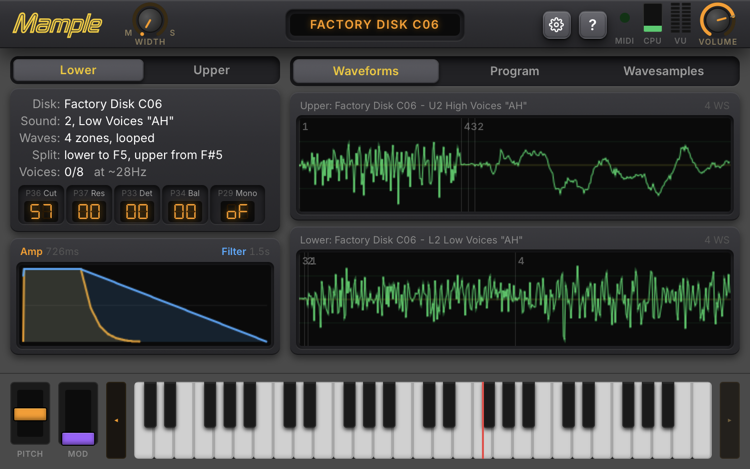
Mample's window is 750 × 469 pixels at 100 % and is divided into a header bar, a left column of readouts, a right column of waveform displays, and a performance row of wheels and keyboard along the bottom.
Header Bar
From left to right:
| Control | Function |
|---|---|
| MAMPLE | Branding. Does nothing. |
| WIDTH | The stereo width of the output, from M to S. See Output. |
| Disk name | The loaded disk's title, or NO DISK. Click it to open the Disk Library browser. |
| ⚙ Settings | Opens the Settings dialog. |
| ? About | Opens the About dialog: version and build date, links to the website, this manual and the support desk on GitHub, credits and licences — and, in builds with the network feature, Report an Issue… When a newer version of Mample exists, a red dot sits on this button, and the About dialog shows Update available: and the version; click that line to open the changelog on knivesonstrings.com/mample, where the latest build is offered. Mample never downloads or installs anything itself. See Checking for updates. |
| CPU | Load meter for this instance. |
| VU | Output level. |
| VOLUME | Master output level. Apart from this and WIDTH, everything about the sound comes from the disk. A new instance starts at 75 %, marked by a small tick on the knob's arc, which leaves headroom for loud sounds and chords. Hover over the knob, drag it or Tab to it and a readout shows the setting and the gain it applies (75 % is −7.5 dB), so you can return to an exact level. Double-click the knob to put it back to 75 %. With the knob focused, the arrow keys step it by 2 % (Shift: 1 %), and Home/End go to the ends. |
Left Column
Status strip. A MIDI activity light, the number of voices sounding out of eight, and an approximate rate readout for the loaded sound's first wavesample — how fast the DOC cycles its table at its native clock. Rates of 1000 Hz and above read in kHz, lower ones in Hz. If a load fails, the reason appears here in red.
LOWER and UPPER tabs. Above the info panel, two tabs choose which half the panel and the envelope graph below it describe. Each half can come from its own disk, so each tab shows its own half's disk, sound, wavesamples, parameters and envelopes. Click a tab, or Tab to it and press Enter or Space. Mample opens on LOWER when a Lower sound is loaded, otherwise UPPER. Loading a sound into a half switches to that half's tab, and so does unloading a half when one is left. A half with nothing loaded has a dimmed tab: you can still select it, and its rows then read —. The tab you pick lasts while the window is open and is not saved with your project.
Info panel.
| Readout | Meaning |
|---|---|
| Disk | The title of the disk this half was loaded from. |
| Sound | Which of that disk's three sounds this half holds, and its name: 2, High Voices "AH". |
| Waves | How many key zones this half has, and whether they loop: 8 zones, looped, or 5 zones, 3 looped when only some do. Each wavesample owns the keys up to its own top note, so this is both the wavesample count and the number of splits across the half. It is the row that tells you a disk read correctly: a percussion kit is many narrow zones, a piano a few wide ones, and one zone where you expected eight means the load did not get what you wanted. |
| Split | Where the keyboard divides, as the engine actually routes it: lower to B4, upper from C5 means B4 and below play the Lower sound and C5 and above the Upper. With one half loaded the row is labelled Keys and gives the range that half covers. This row describes both halves, so it is the same on either tab. |
| P36 CUT / P37 RES / P33 DET / P34 BAL | Four of the selected half's program parameters, each shown with its parameter number and on the scale the Mirage's own panel displays: filter cutoff (P36), filter resonance (P37), oscillator detune (P33) and oscillator balance (P34). The numbers are the machine's, so you can dial the same parameter up on hardware and check that the two agree. |
Envelope display. The amplitude envelope (AMP, amber) and filter envelope (FLT, blue) of the selected half's program drawn on one graph with a shared time axis. Each trace is scaled to its own peak, and the legend shows how long each envelope runs. The curves are generated by the engine's own envelope code — the same rates and velocity scaling that shape the sound — so what you see is what plays.
A switched-off envelope or filter. The amplitude envelope and the analog filter can be switched off in Settings → Sound. While one is off, its trace in the graph is drawn thin and faded in its own colour, and its legend's tooltip says it is switched off.
Right Column
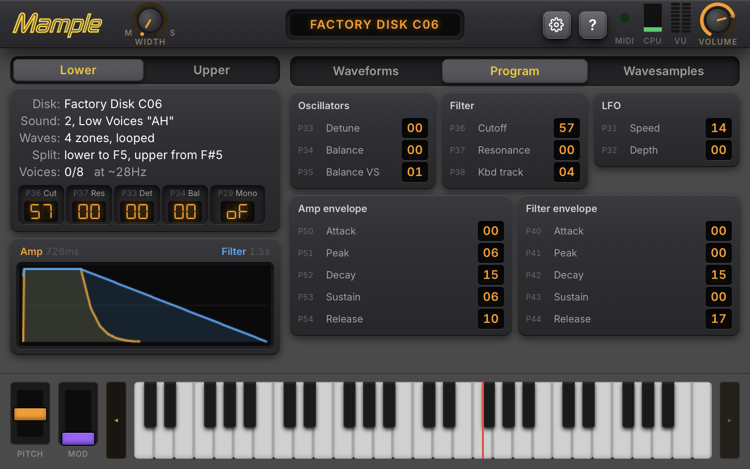
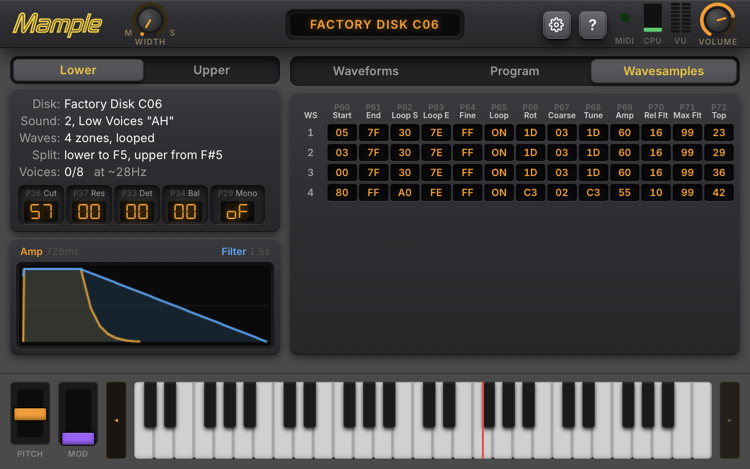
Three tabs across the top choose what this column shows: Waveforms, Program and Wavesamples. All three are for reading; nothing here changes the sound.
Waveforms. Two waveform panels, Upper and Lower. Each header names what that half is playing — the disk, the half and slot, and the sound's name, as in Upper: Factory Disk C06 - U2 High Voices "AH" — followed by the number of wavesamples loaded there. The trace is the sample data in that half. A half with nothing loaded shows an empty panel. Right-click either panel, or the keyboard, for Unload Upper and Unload Lower (see After loading).
Program. The program parameters of the half chosen with the LOWER and UPPER tabs, each with its parameter number: oscillators, filter, LFO, amplitude envelope and filter envelope.
Wavesamples. One row for each wavesample in that half, with its parameters from P60 to P72: start, end, loop points, tuning, level and top key.
Performance Row
The PITCH and MOD wheels and a 49-key keyboard, described in Playing. The red line across the keys marks the split between Lower and Upper.
Loading Sounds
The Disk Library browser
Click the disk name in the header. The browser scans Documents\KnivesOnStrings\Mirage_Disks\ and lists every Mirage disk image it finds. While a large library scans, a progress line shows how far it has got.
- Browse by: Disk | Sound, left of the search box, chooses how the library is listed. Disk is the list of disks described below. Sound lists every sound in the library -- every Lower and Upper half of every disk -- in one list (see Browsing by sound). The browser reopens in the view you used last.
- Search filters the list as you type, by disk title, sound names, program and wavesample names, and tags. A disk the catalog does not know is titled by its filename, so its filename is what you search for.
- Tags show under each sound. Click one to list only the disks carrying it; the tag then shows as a chip below the search box -- click it to clear it. The search and the tag apply together.
- ★ Favourites, beside the search box, lists only the disks with a starred sound and shows only their starred sounds; click it again to see everything. It works together with the search and the tag (see Names and the catalog).
- Subfolders are shown as folders. If you keep your disks filed into directories, the list groups them the same way, nested as deeply as your filing goes. Click a folder's name to collapse or expand it; they start expanded. A library kept in one flat folder simply shows a flat list.
- Select a disk to see its sounds, one per line (the browser opens at the disk you last used, or at the one that is loaded; otherwise at the first disk). Each line is tagged with its half and slot — U1, L1, U2 and so on, upper above lower within each slot, matching the waveform panels — followed by the sound's name and a LOAD button. A sound that is currently loaded shows LOADED and is highlighted. A three-slot disk, which is most of them, shows all six of its sounds at once.
- The browser's own header names the disk you have loaded, beneath the DISK LIBRARY title. If the two halves came from different disks, it names whichever was loaded most recently.
- Loading is per half. Load Slot 1's Lower and Slot 2's Upper if you like, or a Lower from one disk and an Upper from another; the LOWER and UPPER tabs show each half's disk and sound, and each waveform panel names its own half's disk. A load replaces only the half you load into: the other half keeps its own sound, from its own disk, untouched. A note you are holding on the other half plays on through a load; a note still sounding on the half you load into stops as the new sound arrives. A few settings belong to the whole instrument rather than to a half -- master tune, bend range, velocity sensitivity, key balance and the modulation sources. As on a Mirage, which takes them from the disk it boots from, they come from the first disk you load into an empty Mample, and loading into either half afterwards leaves them alone. Unload both halves and the next disk you load sets them again. They are saved with your project.
- Each sound line has an audition button (▶) before LOAD: it plays the sound before you load it (see Auditioning a sound).
- Under each sound the browser lists its wavesamples, with the keys each one covers, and its programs.
- The pencil button on a disk opens the metadata editor for the disk's title, sound names, program names and tags (see Names and the catalog).
- Escape closes the browser (with a sound on preview, the first Escape ends the preview). The disk list, like the rest of Mample's dialogs, can be worked from the keyboard: on a sound's line, Space auditions it and Enter loads it.
If the library is empty, the browser says so and tells you which folder to fill.
Browsing by sound
Choose Browse by: Sound to look for a sound rather than a disk. Every sound half in the library is one line: its star, its name, its tags, where it lives -- the disk and the half and slot, for example A07 · L2 -- its audition button and LOAD. A sound with no name is listed by where it lives.
- TYPE groups the list under the six sound types -- Keys, Strings, Brass & wind, Synth, Percussion, Voice -- and Untagged, which holds every sound in none of them. A sound is typed by its tags; one with no tags at all is typed by its name where the name says (piano, choir), as in the disk list. All shows every group, each under its heading; a type button shows that group alone. A sound with two types -- an organ tagged keys and synth -- is listed in both. Each button shows how many sounds it would list.
- HALF: Lower | Upper | Both limits the list to Lower halves, Upper halves or both (the default). A sound loads into its own half -- a Lower sound into Lower -- so when you are choosing for the bass end of the keyboard, Lower shows only what can go there.
- Tag chips, below, are every other tag in your library -- pad, bass, ambient, your own -- each with its count. Press one to list only the sounds carrying it; press several to narrow further; press again to release.
- Search and ★ Favourites work here as in the disk list, and carry over when you switch views.
- LOAD on a line loads that sound into its own half.
The list holds every sound in a large library (two and a half thousand or more) and scrolls smoothly: only the lines on screen are drawn.
Auditioning a sound
The ▶ button on a sound's line, in either view, plays that sound without loading it:
- The walk. Mample plays one short note in each key zone of that sound, low to high -- each wavesample the keyboard can reach, one note per zone, about a third of a second each -- so a multisampled piano or a drum kit is heard across its whole range in under three seconds.
- On preview. Then the sound stays on preview: your keyboard -- and your DAW's MIDI, so you can audition against a playing track -- plays it on the keys of the half it would load into. A Lower sound plays below the split, and the keys above it still play your loaded Upper; an Upper sound the reverse. Press a key during the walk and the walk stops at once.
While a sound is on preview, its ▶ is lit, and a bar reads Previewing:
- press LOAD -- the sound is loaded into its half, as from its line, and the browser stays open for your next audition;
- audition another sound, which takes over;
- press CANCEL, press the lit ▶ again, or press Escape;
- close the browser.
Nothing about your loaded sound changes while you audition: when the preview ends, your keyboard plays exactly what it did before. A note you were holding on that half when the preview started is released, as if you had let go of the key. The preview is never saved: a project saved while a sound is on preview reopens with the sound you had loaded. A screen reader hears Previewing Lower 2, Electric Bass 2 when a preview starts and Preview ended when it ends.
After loading
The waveform panels, info panel, envelope display and keyboard split update to the new sound. Everything you need to know about the loaded sound is on the main window; the browser can be closed.
Unloading a half. To take a sound out without loading another over it -- an Upper you are not using, say -- right-click a waveform panel or the keyboard and choose Unload Upper or Unload Lower. Each is available only while that half has a sound in it. The half falls silent, its panel shows No Sound Loaded, and the other half plays on untouched. Your project remembers it: when it reopens, that half is still empty. Unload both halves and Mample is back to a fresh instance, with no disk loaded. To fill a half again, load a sound into it from the browser.
A load that fails — a file deleted since the scan, an image Mample cannot read — is reported in the status strip in red, and the previous sound stays loaded. The info panel always describes the sound the engine really holds.
A damaged image still loads, because its intact sounds may still play: typically an .hfe from a partial conversion, some of whose sectors are simply not there, or cannot be read. The status strip says so when the disk opens and names what is affected, for example MELPRO7_edm.hfe is damaged: 15 of 480 sectors missing and 1 unreadable (OS, Lower 1 parameters, Lower 1 samples). A sound named there will not play as recorded: where sectors are missing its notes may stop short or play nothing, where a sector is unreadable they may play with errors, and missing parameters load as zeros. The others are unaffected.
An image file that is not the length of one Mirage disk is a different matter: a .img cut short in a download or a copy, or with extra bytes after it. Nothing in it says what is missing, so it does not load, and the status strip says why, for example Could not load MYDISK.img — not a complete Mirage disk (450,048 of 450,560 bytes). The sound you had loaded keeps playing.
Saving with your project
Mample saves, for each half, the disk it was loaded from and the slot (or that the half is empty), together with the Amplitude Envelope and Analog Filter switches, the MIDI receive channel and the VOLUME setting, with your DAW project. (A project saved by a version before 0.6.56 opens with VOLUME at 75 %, whatever it was set to: that version lowered the default to leave headroom. Set it again and save, and it is kept from then on.) When the project reopens, each half is reloaded from its own disk.
Mample remembers each half by its sound -- that half's own part of the disk -- as well as by where the file was, so saving a different sound to the same disk (from DSKlusion, say) leaves it alone. If you have moved or renamed the file within your library, Mample looks for the sound there: first where the file would be if your whole library had moved (a new drive letter, or a project from another computer), then the file's own name and any names the library browser has seen that disk under, in every folder of your library, and then every disk in it; when it finds it, it loads it and saves the new location the next time you save the project. A disk you moved to another folder under the same name is found even in a very large library. The search never takes more than half a second, however slow your disks or network share, so a project never stalls while it opens; in a very large library a disk that was both moved and renamed may not be reached -- load it again from the browser. Once a half has come back [MISSING], undoing or switching back to that state does not search again until something is added to or removed from the top of your library folder, or you load a disk. If no disk in your library holds that sound -- the file is gone, or that sound on it has since been changed -- that half loads nothing and its panel shows the disk's name with [MISSING]; the other half and the rest of the state are unaffected. A file of the same name but a different sound is never loaded in its place. Put the image back in your library and reopen the project to restore the sound.
Playing
The keyboard
The on-screen keyboard is a four-octave window (49 keys) into the Mirage's five-octave range. It opens on C3–C7; the ◂ and ▸ buttons at either end page it down to C2–C6 and back. Click a key to play it; drag across keys for a glissando. On-screen keys always play at a velocity of 100 — use a MIDI controller for the sound's full dynamic range. The window follows the loaded sound's split until you page it yourself.
The red line marks the split: keys left of it play the Lower sound, keys right of it the Upper. If the split falls outside the visible window, a stripe at the relevant edge shows the split note's name.
The wheels
PITCH bends by the instrument's bend range at full travel — the Mirage's P22, set by the disk the instrument settings come from (see Loading is per half above), ±2 semitones on most disks and up to ±12 — and springs back to centre when released.
MOD latches where you leave it and controls vibrato depth, with one Mirage rule worth knowing: if the loaded sound has its own LFO depth programmed, the wheel does nothing — the sound vibratos on its own and the OS ignores the wheel. Only sounds with LFO depth set to zero hand vibrato depth to the wheel. That is how the Mirage's OS 3.2 behaves, and Mample reproduces it rather than second-guessing it.
Voices
Mample has eight voices, allocated exactly as the Mirage's firmware allocates them: strictly in rotation, with released notes left to ring out through their release envelopes. A ninth note takes over the oldest voice's oscillators immediately, which cuts that voice off — also exactly as the hardware does. The status strip counts voices in use.
The sustain pedal (MIDI CC 64) holds notes until the pedal is released, as it does on a Mirage with a footswitch connected.
Velocity
Velocity response comes entirely from the loaded sound's own parameters — the Mirage's velocity-to-level and velocity-to-envelope-rate settings for amplitude and filter. Some factory sounds respond strongly, some not at all. Mample applies the firmware's velocity laws as measured on a running Mirage, so a sound that was quiet at low velocity on the machine is quiet here too.
Output
The WIDTH knob sets how the voices reach the two outputs. At M, the default, the output is mono and sent to both channels, like the single jack of a DSK-8 Mirage. At S, each voice goes wholly to the left or the right output, as on a DSK-1. Between the two, some of each side is mixed into the other. Nothing is panned: a voice's side is fixed. The setting is saved with your project.
MIDI
MIDI Channel
Settings → MIDI / AUDIO → MIDI → Receive Channel selects Omni (All) or a single channel, 1–16. The choice is saved with your project and applies in every format, so in a DAW you can either leave it on Omni and route in the host, or pin the instance to a channel.
Messages
| Message | Effect |
|---|---|
| Note On / Note Off | Plays and releases notes, with velocity. |
| Pitch Bend | The bend range (P22) at full deflection: ±2 semitones on most disks, up to ±12, from the disk the instrument settings come from. |
| CC 1 — Mod Wheel | Vibrato depth, subject to the Mirage rule described under The wheels. |
| CC 64 — Sustain Pedal | Holds notes while ≥ 64; releases them when < 64. |
| CC 120 / CC 123 — All Sound Off / All Notes Off | Silences everything. |
Not supported: Program Change, Bank Select, other controllers, aftertouch, SysEx. There are no programs to change — the disk is the program.
Host automation
Four parameters are exposed to the host and can be automated or mapped to hardware:
| Parameter | Range |
|---|---|
| Volume | 0–1, the VOLUME knob |
| Stereo Width | 0–1, the WIDTH knob |
| Pitch Bend | −1 to +1, the PITCH wheel |
| Mod Wheel | 0–127, the MOD wheel |
Settings
Click ⚙ in the header. The dialog has tabs for SOUND, DISKS, MIDI / AUDIO, APPEARANCE, PRIVACY (in builds with the network feature enabled) and ADVANCED. Settings save automatically.
Sound
| Setting | Description |
|---|---|
| Note Timing | Tight (the default) plays a note the instant it arrives. Authentic adds the delay of a real Mirage: about 4.0 ms before a note starts and 1.6 ms before it begins to release, as OS 3.2 takes them. |
| Render Quality | Direct is the lightest on the CPU. Standard is next, and 2x and 4x Oversample use more CPU. Your choice is remembered. |
| Amplitude Envelope (under ENGINE FEATURES) | On (normal) or off. Off removes the amplitude envelope, so the sample plays at full level for as long as the key is held. Saved with your project. |
| Analog Filter (CEM3328) (under ENGINE FEATURES) | On (normal) or off. Off takes the CEM3328 filter out of the path, so you hear the raw DOC output. Saved with your project. |
The two ENGINE FEATURES switches are for hearing what a disk contains as opposed to what the Mirage did with it, and for the occasional sound whose envelope was programmed to near-silence. While one is off, the envelope graph draws its trace thin and faded.
Disks
| Setting | Description |
|---|---|
| Sound Disks | The folder scanned for disk images. Browse opens a folder chooser; the path beside it is where Mample is reading from now, and cannot be typed into. Changing it rescans the library immediately. The default is Documents\KnivesOnStrings\Mirage_Disks\, and a folder that is no longer reachable, on an unplugged drive for instance, falls back to that default rather than showing an empty library. Your disk names stay in Documents\KnivesOnStrings\Mirage_Disks\disk_catalog.json whichever folder you choose. |
Appearance
| Setting | Options | Description |
|---|---|---|
| Window Scale | 50 %, 75 %, 100 %, 150 %, 200 % | Resizes Mample's window, and everything in it, by the amount you pick. Each option names the size it will produce in pixels, so you can tell in advance what will fit. The choice is saved with the project, so a reopened session comes back the size you left it, and each instance in a session can be a different size. It is also remembered on this computer: a new instance opens at the size you last chose. |
| Theme | Dark, Light | Mample's colour scheme. Dark is the default. The choice belongs to your computer, not the project: every Mample instance uses it. |
| Onboarding | Show Tour | Runs the guided tour again from the beginning. The tour opens by itself the first time you run Mample, and again only after an update that revises it, however you leave it, so this button is the way back to it. Starting it closes the Settings window. |
The guided tour. The first time you run Mample, a short tour opens by itself a moment after the window appears. It is five steps — what Mample is, where disks come from (identical copies are hidden by default; the library's menu has the switch), how to browse by disk or by sound, what a loaded disk is telling you, and how to play it — and the disk steps open your disk library while they explain it. Skip tour, Escape and finishing it all count the same: it does not open by itself again until an update revises it. In builds with the network feature enabled, a fifth step appears if you have not yet answered the privacy question; that step has no Next, only the two answers. See Privacy.
Dialogs — Settings, the disk browser, About — do not scale with the window. They shrink to fit inside it and scroll, so at 50 % they are cramped. Window Scale is the first thing in Appearance, so you can always reach it to pick a larger size again.
Mample's window cannot be resized by dragging its edge — pick a size from Window Scale above instead. On a Windows display set above 100 %, the window also scales with the system, as any application's does, and the two compound: 150 % here on a 150 % display is a large window.
MIDI / Audio
| Setting | Description |
|---|---|
| Receive Channel (under MIDI) | Omni (All) or Channel 1–16. Saved with the project. |
| Audio Output | Standalone only. Driver Type (when there is more than one), Device, Sample Rate and Buffer Size, an indicator showing whether the audio device is running, and a Test Tone button. On Windows the driver types are the Windows Audio (WASAPI) variants, DirectSound and ASIO. |
| MIDI Input Devices | Standalone only. Enable the MIDI ports the standalone app should listen to. |
In the standalone app these device choices are stored in Documents\KnivesOnStrings\Mample\Mample.standalone.settings. In a DAW, audio and MIDI devices belong to the host and these sections do not appear.
Privacy tab
Present only in builds with the network feature enabled. It holds two separate choices.
- PRIVACY. A single switch, Send anonymous usage data, turns anonymous usage reporting on or off. The section also shows your random install id and a View privacy policy link.
- UPDATES. Check for updates sets how often Mample asks whether a newer version exists: Daily, Weekly (the default), Monthly or Never. Check now asks at once, whatever the setting, and the line beneath says what it found: You're up to date., Version … is available., or Couldn't reach the update server. Below the controls, Last checked gives the time of the last successful check, always written like 16 Oct 2026, 14:02 (day, month, year, 24-hour, your local time), or Never checked.
See Privacy.
Privacy
Mample can be built with an optional network feature that supports three things: anonymous usage statistics, the Report an Issue… button in the About dialog, and the check for a newer version. Mample ships with this feature switched on, and sends no usage data until you have answered the question below. (It was off in builds before v0.5.106; DSKlusion has it on as well. In a build with the feature off, Mample never opens a network connection, the PRIVACY tab is absent, the About dialog has no report button and no update notice ever appears.)
The first-run question
Mample asks once, and where it asks depends on the tour. For most people it is the tour's last step; skip the tour before reaching it and Mample asks in a prompt of its own instead. Either way the words are the same:
Help improve Mample. Mample can send anonymous usage data. The plugin version, your operating system, your host and its version, sample rate, buffer size, session length, and a random install id created when you opt in. Never audio, never your samples or disks, never anything that identifies you. You can change this at any time in Settings → Privacy, under "Send anonymous usage data".
Help improve Mample turns reporting on; No thanks leaves it off. Either answer is remembered and the question is not asked again — including by the tour, which drops that step once you have answered. View privacy policy opens the policy in your browser.
What is sent, and what is not
When reporting is on, Mample sends a small record when a session starts and ends, when the issue-report form is opened, and when you turn reporting off. Each record carries the product name and version, the operating system, the host (a DAW's name, or Standalone) and a random installation identifier; the session-start record adds the sample rate and buffer size, and the session-end record the session's length. The installation identifier is generated on your machine and is not derived from anything about you or your computer.
Nothing else is sent. Not audio, not sample data, not disk images, not file names, not MIDI, not your projects.
Checking for updates
Separately from usage data, Mample asks our server whether a newer version exists. The request sends the product name and nothing else: no install identifier, no version number, no licence or serial, nothing you have typed, played or loaded, and no cookies. It identifies itself only as KosNet/ and the version of our networking component, the same for everyone running that version, and its language header is a fixed *, so your language is not sent either.
You choose how often under Settings → PRIVACY → Check for updates: daily, weekly or monthly, or never. Weekly is the default. Mample checks at most once per editor window you open, a few seconds after it appears, and only when that much time has passed since the last check. On Never it makes no automatic check at all, and Check now asks once, only when you press it.
When a newer version is found, a red dot appears on the ? button in the header, the About dialog names the version, and Mample stops asking until you install it. About's Update available line links to the changelog on Mample's product page, where the latest build is offered; Mample never downloads or installs anything by itself.
The update check and usage data are separate choices: switching one off leaves the other as it is.
Changing your mind
Settings → PRIVACY → Send anonymous usage data turns reporting on or off at any time. Turning it off sends one final opt-out record so the installation identifier can be forgotten, and then nothing more.
Questions about privacy: privacy@knivesonstrings.com. The privacy policy is at knivesonstrings.com/mample/privacy.
Support
Bug reports & feature requests: github.com/Knives-On-Strings/mample/issues — the issue templates ask for what we need. No source code is hosted there; it is the support desk.
Report an Issue… (network-enabled builds): in the About dialog. It first checks that the report service can be reached (a connection that carries nothing about you, made whether or not usage reporting is on), then opens the report form in your browser with the version and host already filled in. If the form cannot be reached, Mample shows the form's address with a Copy URL button.
Email support: support@knivesonstrings.com
General questions: hello@knivesonstrings.com
Website: knivesonstrings.com/mample
When reporting a problem, the version and build date from the About dialog and the disk involved (name, or a description if you cannot share the image) are the two things that help most.
Appendix
Mirage parameters shown in Mample
Mample displays a handful of the loaded sound's program-1 parameters. The numbers are the Mirage's own parameter numbers, for cross-reference with the Mirage manuals.
| Readout | Mirage parameter | Meaning |
|---|---|---|
| CUT | 36 | Filter cutoff frequency |
| RES | 37 | Filter resonance |
| DET | 33 | Oscillator detune (the second oscillator of each voice against the first) |
| BAL | 34 | Oscillator balance. The Mirage calls P34 D.O. Balance; the panel used to caption it MIX. |
| AMP envelope | 50–54 | Amplitude envelope: attack, peak, decay, sustain, release |
| FLT envelope | 40–44 | Filter envelope: attack, peak, decay, sustain, release |
| Split | — | The key split as the engine routes it. Derived from the wavesample key ranges on the disk. |
The rest of the program and the wavesample parameters are on the Program and Wavesamples tabs (see Right Column). Anything else on the disk, such as velocity sensitivities, is loaded and used but not displayed.
Troubleshooting
| Symptom | Check |
|---|---|
| The plugin window is a plain grey panel, or blank | Windows: the WebView2 Runtime is missing. Install it (see Installation (Windows)) and reopen the plugin. macOS 10.15: update Safari, which updates the engine Mample's window is drawn with. |
| The Disk Library says no disks were found | Put your images in Documents\KnivesOnStrings\Mirage_Disks\ (subfolders are fine) and reopen the browser. Files that are not Mirage images are skipped even if they have a disk extension. |
| A disk is listed but LOAD does nothing | Read the status strip: it reports a file that has moved since the scan or an image Mample cannot decode. |
| No sound | Check the VOLUME knob, the host's routing, and Settings → MIDI / AUDIO → Receive Channel (Omni is the safe choice). In the standalone app, check the audio output device there too. |
| Sound, but only on part of the keyboard | Only one half is loaded: the empty half's tab above the info panel is dimmed — or you are playing on the far side of the split. Load the other half from the browser. |
| The mod wheel does nothing | The loaded sound has its own LFO depth programmed, and the Mirage ignores the wheel for such sounds. This is faithful behaviour, not a fault. |
| Pitch bend range is too small or too large | It is the Mirage's P22, from the first disk loaded into an empty Mample (±2 semitones on most disks). Unload both halves and load a disk saved with the range you want. |
| Notes cut off when playing busy passages | Eight voices, hardware allocation: the ninth note steals the oldest. Also faithful. |
| High CPU | All eight voices ringing costs about a quarter of a core. Shorter release envelopes on the disk mean fewer voices ringing at once. |
| A project reopened with [MISSING] on a half | No disk in your library holds that half's sound any more: the image was deleted, moved out of the library, or changed. Put it back in your library and reopen the project; the rest of the project state is intact. |
What Mample does not do
- No sampling, editing or saving. Wavesample parameters, loop points and programs are read from the disk and shown; none can be changed. DSKlusion does all of this.
- No sequencer. Sequences stored on a disk are ignored.
- No operating system. Mample does not run Mirage OS code and needs no OS disk. If you want OS-specific behaviour, that is DSKlusion.
- No program change. A Mirage disk is the program; MIDI Program Change and Bank Select are not implemented.
- No iPad version yet. Mample runs on Windows and macOS.
Trademarks & Attribution
Ensoniq and Mirage are trademarks of Ensoniq Corp. Mample is an independent product, not affiliated with or endorsed by Ensoniq or its successors.
VST is a trademark of Steinberg Media Technologies GmbH. ASIO is a trademark of Steinberg Media Technologies GmbH, registered in Europe and other countries. CLAP is an open plugin standard developed by u-he and Bitwig. Windows, Microsoft Edge and WebView2 are trademarks of Microsoft Corporation. Apple, macOS, Safari, Logic Pro, GarageBand and Audio Units are trademarks of Apple Inc.
Open-Source Components
Mample's compiled binary includes the following open-source software:
- JUCE 9 — cross-platform audio plugin framework. © Raw Material Software Limited. Used under the JUCE commercial license.
- clap-juce-extensions — CLAP format support for JUCE. MIT License.
- VST3 SDK — © Steinberg Media Technologies GmbH. Used via JUCE.
- ASIO Interface Technology — © Steinberg Media Technologies GmbH. Used via JUCE, which supplies the headers. Mample hosts ASIO drivers on Windows; it does not include or redistribute the ASIO SDK.
- DSPFilters by Vinnie Falco — MIT License.
- r8brain-free-src by Aleksey Vaneev — sample-rate conversion. MIT License.
- melatonin_blur and melatonin_inspector by Sudara — MIT License.
- mc6809 by elmerucr — 6809 CPU core. MIT License. Part of the shared engine library; not exercised by Mample, which runs no Mirage code.
- React and React DOM — © Meta Platforms. MIT License.
- Zustand — MIT License.
- Tailwind CSS — MIT License.
- Inter typeface — © The Inter Project Authors. SIL Open Font License 1.1. Mample's interface face.
- Noto Sans Symbols 2 and Noto Sans Math — © The Noto Project Authors and Google LLC. SIL Open Font License 1.1. Mample bundles small subsets of these, carrying only the arrows, carets, triangles and marks the interface draws, under the family name Virage Symbols.
- Courier Prime typeface — SIL Open Font License 1.1. Carried in the shared stylesheet; Mample renders no monospace.
- IBM Plex Mono typeface — © IBM Corp. SIL Open Font License 1.1. As above.
- Mirage7 Classic typeface — derived from DSEG7 Classic, © keshikan, with the glyphs that differed redrawn to match the Mirage's own display (the open 9, for one). SIL Open Font License 1.1. The 7-segment digits of the data window's readouts.
Mample User Manual v0.7.8 — November 2026 © 2026 Knives on Strings. All rights reserved.
For the most up-to-date version of this manual, visit knivesonstrings.com/mample/manual.